.svg)

.svg)

.webp)
.webp)

- Best for early-stage teams that need a fast, predictable HR setup: Justworks offers simple onboarding, transparent monthly pricing, and strong payroll support for businesses hiring their first employees.
- Best for growing companies managing compliance risk: ADP TotalSource provides strong HR infrastructure and multi-state compliance support once headcount starts scaling.
- Best for small businesses that want to lower their health costs: Ignition Benefits is a brokerage that helps founders reduce premiums without sacrificing coverage.
A PEO is the fastest way to get payroll, compliance, and benefits under one roof. Then enters the dilemma of which one fits where you are right now.
This guide covers the best PEO services for small business in 2026, what each delivers, where each falls short, and when a benefits broker alongside your PEO is the smarter call for your bottom line.
Best PEO for Small Business in 2026: A Quick Overview
Note: Ignition Benefits works alongside your current PEO to lower health benefits costs through full-market audits, Benefits Risk Score analysis, and carrier negotiations, without changing employee coverage or disrupting plans.
Ignition Benefits: Best for Lowering Health Insurance Costs

Ignition Benefits is not a PEO. It is what small businesses use when they want to control spending on health insurance.
Ignition is a benefits broker that runs a full market audit at each renewal and delivers its findings in just 14 to 21 days, compared to the 8 to 12 weeks traditional brokers typically take.
The Ignition client saves 20% in the first year.
Ignition Benefits Key Features
Four things make Ignition Benefits structurally different from the PEOs on this list:
Benefits Risk Score
Every insurance carrier already has a risk score on your workforce, based on age, gender, and location. They use it to price your renewal even though you've never seen it. Ignition Benefits pulls that score before going to market.
So when a 32-person Series A team gets a 14% renewal increase, Ignition can show the founder: your risk score is low, meaning the carrier's actual exposure on your team is small. The gap between that score and what you're paying is exactly where your savings live.
Note: For a healthy startup, a low risk score paired with high premiums is a red flag; you're likely subsidizing someone else's claims.
Full Market Audit at Every Renewal
Your current PEO likely showed you two or three options from their preferred carriers. That is a curated shortlist built around a carrier relationship, not a genuine market check. Ignition runs a genuine full-market audit across every available carrier and every funding structure:
- Fully insured plans
- Level-funded plans
- Self-insured plans
- Captive plans
This ensures no carrier-aligned advice dictates your spend.
See how to reduce small business health insurance costs at renewal.
Full Compensation Transparency on Day One
Many founders do not know this but the Consolidated Appropriations Act of 2021 gives you the legal right to see your broker’s compensation. Yet, most brokers never bring it up because their commission is typically tied to the size of your premium.
Ignition Benefits shows every commission, carrier relationship, and payment structure before the work begins, so you know exactly who is getting paid and why.
AI-Native Process Compression
A traditional broker takes months to return a quote. Ignition’s AI-native tooling compresses this into 14-21 days. For the founder, this requires only two 15-minute calls: one to share your census, and one to review your savings.
Get your free benefits assessment.
Ignition Benefits Pricing
Where Ignition Benefits Shines
- Works alongside your current PEO: Companies can keep platforms like Rippling or Justworks while appointing Ignition through a Broker of Record letter to improve benefits pricing.
- Founder-first process: Built for founders without internal HR infrastructure who need answers fast, not months of consulting meetings.
- Actual visibility into pricing: Shows the carrier risk score and runs a full-market audit instead of presenting limited renewal options.
Where Ignition Benefits Falls Short
- Not built for micro-businesses: If you have fewer than 10 employees and no hiring plans, a PEO might offer better value.
To evaluate how co-employment structures compare to standalone HR management models as you grow, explore our breakdown on ASO vs PEO.
Who Ignition Benefits Is Best For
- Venture-backed founders: You just raised a Series A and need to justify every dollar of burn to the board.
- The first HR hire who’s just found no market review has ever been done, and need to bring the founder a defensible recommendation fast.
- Businesses approaching 50 employees: PEO economics are about to shift, Ignition shows exactly how much the pool pricing is costing you.
1. Justworks: Best for Early-Stage Teams
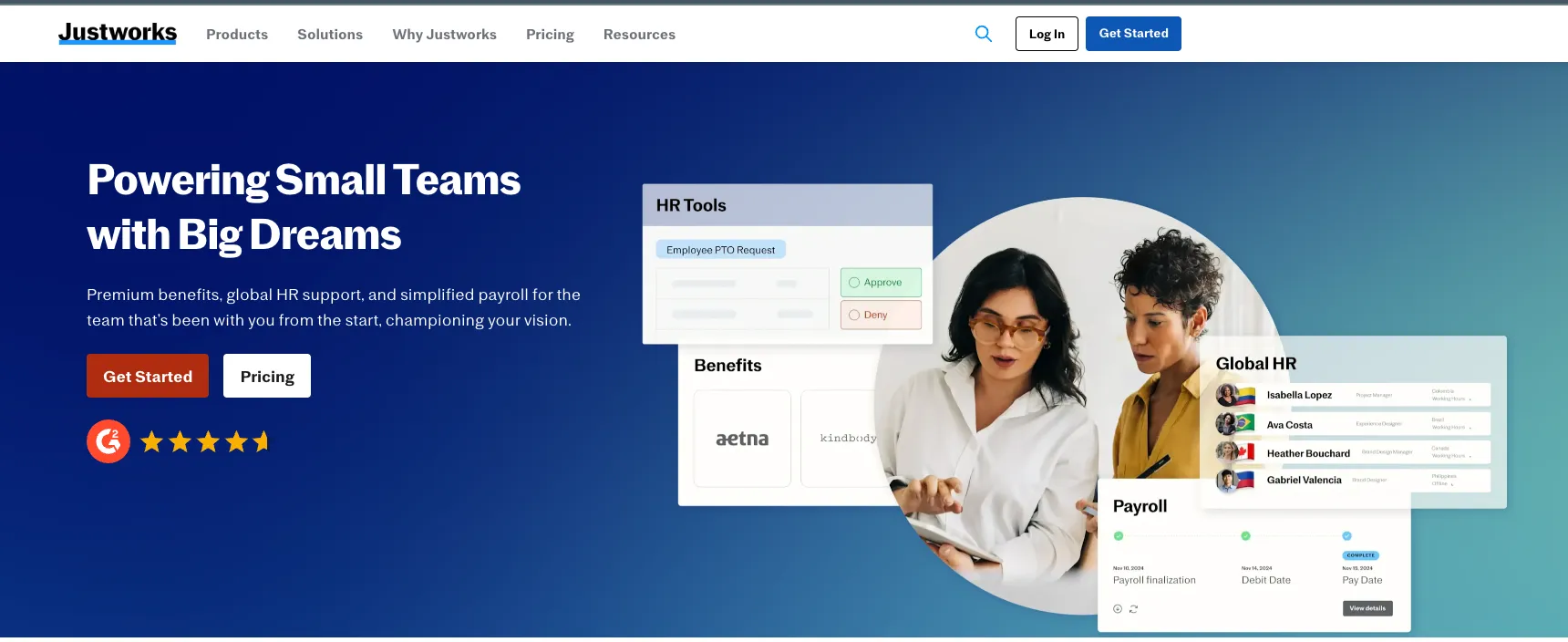
Justworks is one of the strongest options for founders hiring their first employees and needing a straightforward PEO for SMB setup, especially when comparing Gusto vs Justworks. The platform combines payroll, compliance, onboarding, and benefits administration into one clean interface.
That simplicity is the main reason startups adopt it. For a founder without HR infrastructure, Justworks removes operational overhead fast. If you are currently evaluating your options, you can also review our guide to Justworks alternatives to see how other platforms compare.
Key Features
- Automated multi-state payroll and tax filings: As you add employees in new states, Justworks tracks the state-specific compliance requirements so you do not have to.
- 24/7 HR and compliance support: Compliance and benefits questions get answered without building an internal HR function.
- Streamlined onboarding and document management: New hires complete enrollment fast, with all paperwork in one place.
Pricing
Where Justworks Shines
- Pricing you can model in a spreadsheet: Flat per-employee fees so your costs scale predictably with headcount.
- Multi-state compliance without the manual tracking: Hiring in different states means different regulatory environments. Justworks handles the requirements automatically.
If your team is expanding into specific regional markets, partnering with a Hawaii employee benefits broker can ensure your local coverage remains competitive alongside your PEO platform.
Where Justworks Falls Short
- No full market audit: Justworks surfaces options from within its network. It does not review every available carrier against your workforce demographics, so the question of whether you are getting the best benefits rate for your specific team goes unanswered.
- Benefits visibility gaps as you grow: Around 40 to 50 employees, founders start wondering whether the rate reflects their team's actual risk profile. That question does not have an answer inside Justworks.
Who Justworks Is Best For
- Founders who need a fast, clean benefits and HR setup without dedicated HR staff, and want a monthly cost they can predict.
Already on Justworks? Find out if it's still the right call at your headcount
2. ADP TotalSource: Best for Compliance-Heavy Growth
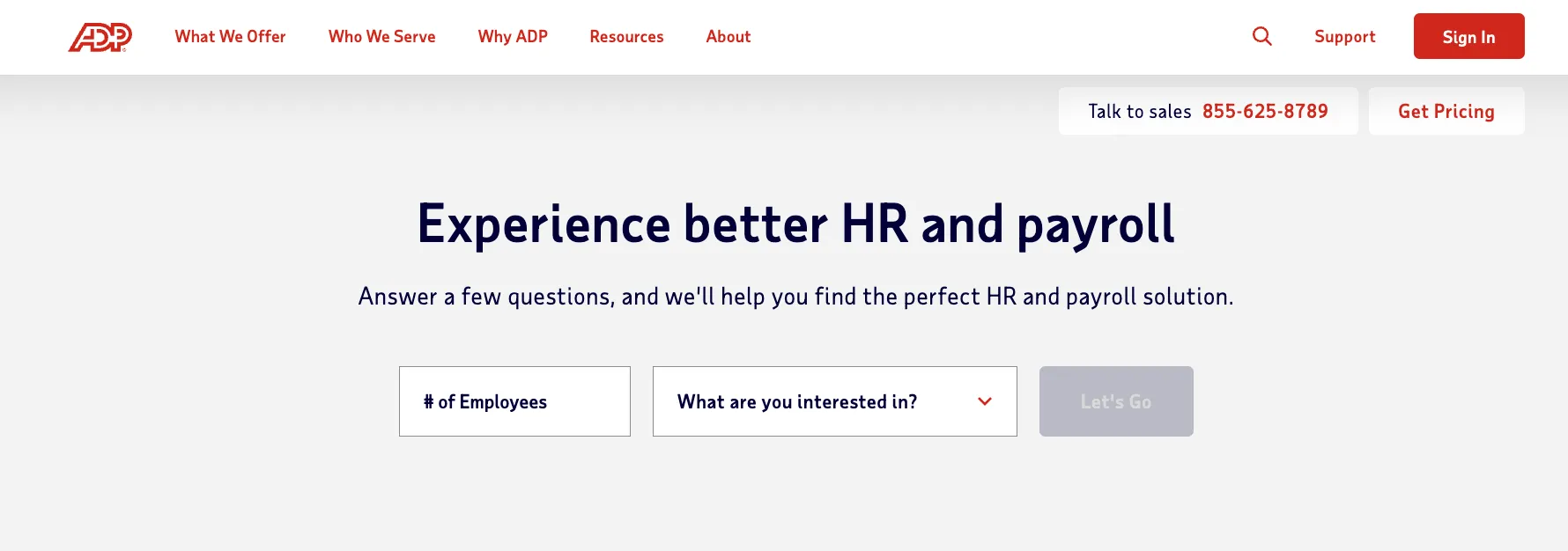
ADP TotalSource operates more like an external HR department than a software platform.
The core feature that separates it from lighter-weight PEOs is the dedicated HR Business Partner: a credentialed HR professional assigned to your account who handles the compliance questions that accumulate fast at a company without a full HR function.
Key Features
- Dedicated HR support: Access to HR professionals and compliance guidance.
- Automated payroll and tax filing: Helps reduce administrative overhead as headcount expands.
- Risk management support: Useful for companies navigating increasingly complex employment regulations.
Pricing
Custom pricing only.
Where ADP TotalSource Shines
- Strong compliance infrastructure: Helpful for companies scaling quickly across multiple states.
- Liability transfer through co-employment: Shared legal exposure on payroll and HR compliance reduces the risk that lands directly on the founder as the team scales.
Where ADP TotalSource Falls Short
- Opaque pricing structure: Benefits spend can become difficult to forecast over time.
Who ADP TotalSource Is Best For
- Mature small businesses who have 150+ employees and need to outsource high-level HR liability entirely.
3. Sequoia One: Best for VC-Backed Small Businesses
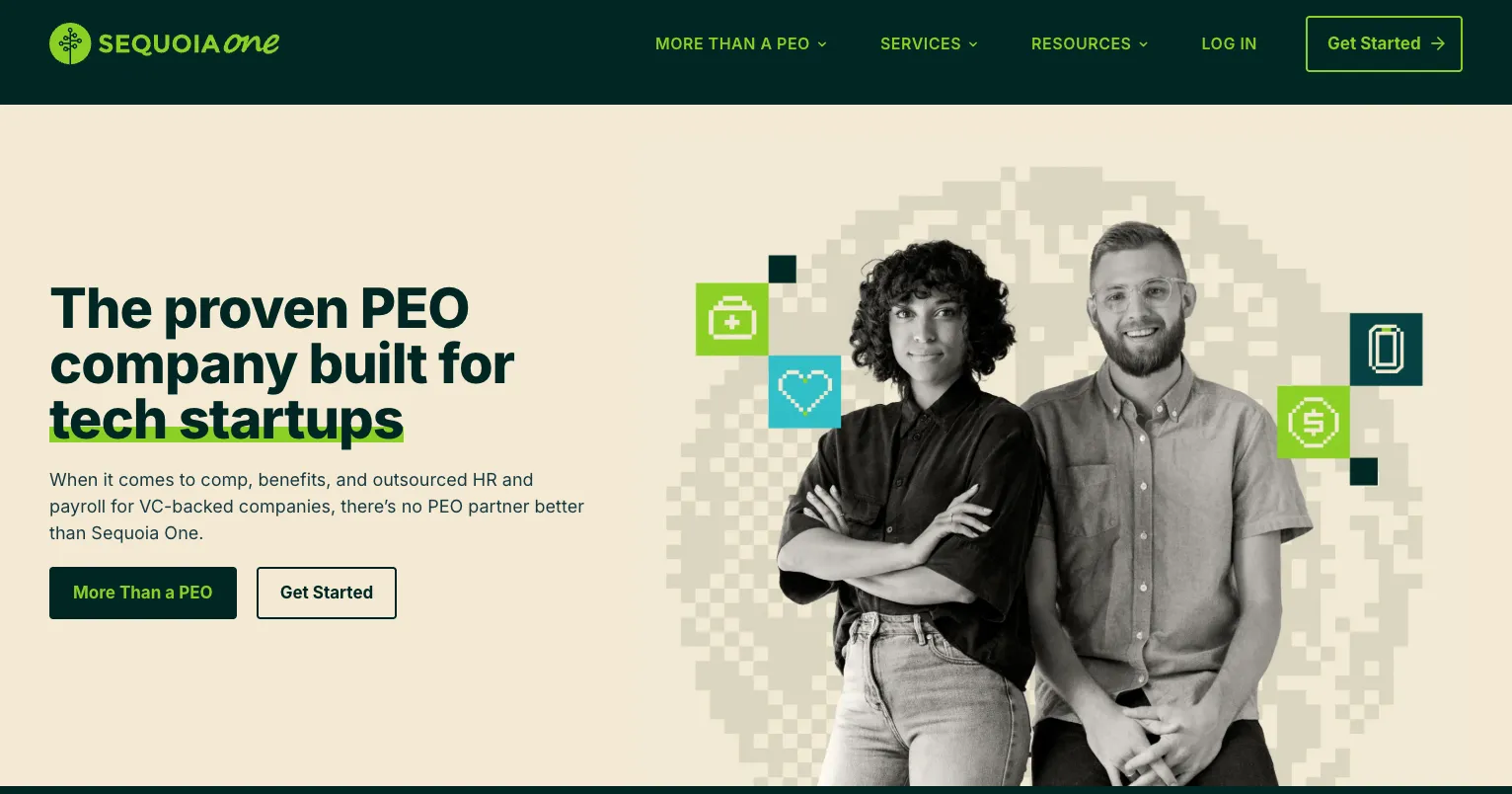
Sequoia One focuses heavily on venture-backed small businesses needing compensation strategy, benefits support, and people analytics while scaling.
The company understands small business hiring dynamics well and that specialization is its biggest strength.
Key Features
- Sequoia OS analytics: Tracks total compensation, benefits spend, and headcount costs in one place, built around what a Series A or B company needs to report to investors.
- Full PEO administration, including payroll, tax compliance, and benefits enrollment.
- High-touch account management for California and New York, where compliance complexity is highest.
- Compensation benchmarking: Helps startups evaluate hiring competitiveness.
To project your overall expenses per hire, you can also use an Employee Cost Calculator.
Pro tip: If you operate in high-complexity markets like California, partnering with a dedicated California employee benefits broker alongside your HR stack can help benchmark rates across local carriers and keep renewal increases transparent.
Pricing
Custom quote only.
Where Sequoia One Shines
- Strong small business ecosystem familiarity: Built specifically around venture-backed growth companies.
- Useful compensation insights: Helpful during rapid hiring periods.
Where Sequoia One Falls Short
- Limited third-party integrations: Fewer external tool connections which creates manual work for ops teams running multi-platform stacks.
- Less flexible outside venture-backed use cases: More niche than broader PEO platforms.
Who Sequoia One Is Best For
- Seed through Series B startups that need compensation strategy and benefits administration together.
4. Rippling: Best for Operational Automation
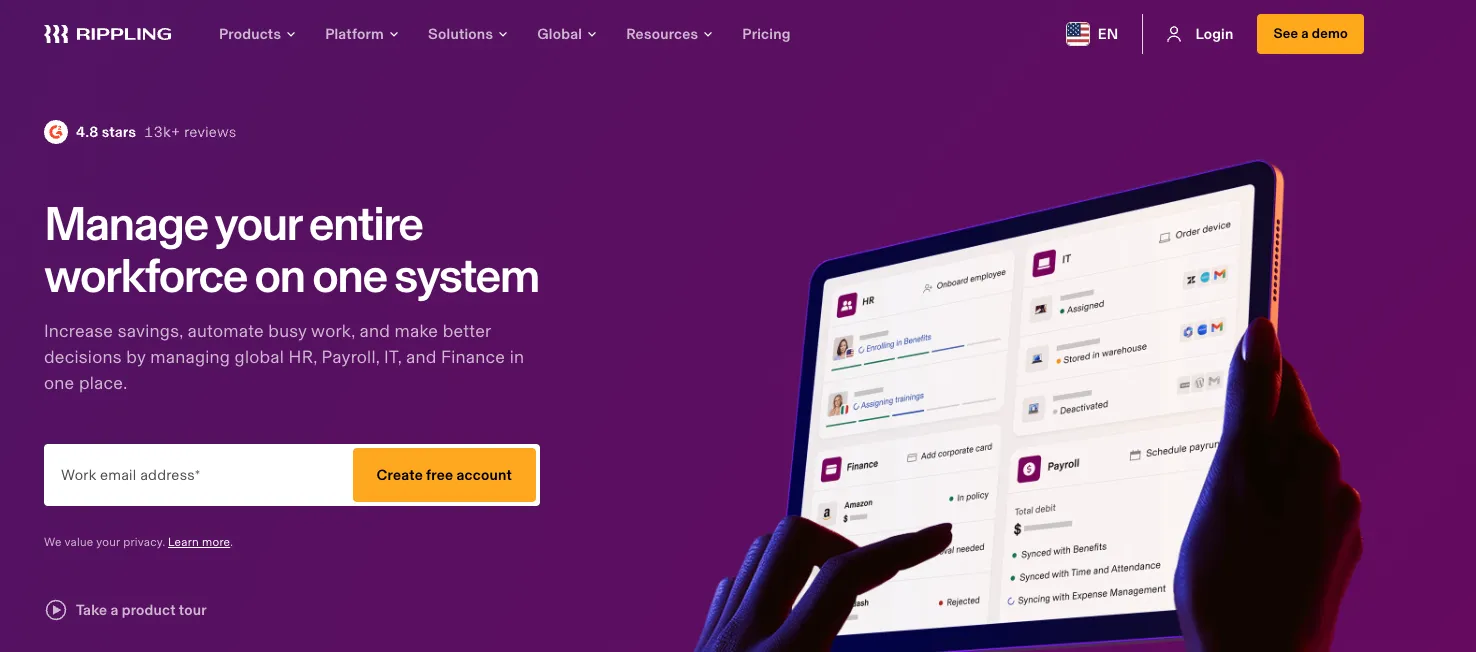
Rippling connects payroll, HR, app access, device management, and workflows into one automated system.
Hire someone once and their payroll, Slack access, laptop permissions, and software accounts all update automatically. That operational efficiency is the core appeal.
Key Features
- Unified employee system: One employee profile powers multiple workflows.
- Payroll and benefits administration: Centralized workforce management.
- Deep automation: Reduces repetitive admin tasks for growing teams.
- 600+ integrations with the tools most modern startup stacks already use.
Pricing
Custom pricing only.
While plans start with a base platform fee, total costs scale depending on added modules and headcount. For a complete breakdown of add-ons and tiers, check out this guide to Rippling pricing.
Where Rippling Shines
- Strong automation capabilities: Saves time for lean operations teams.
- Flexible infrastructure: Companies can move between PEO and standalone HR setups without changing systems.
Where Rippling Falls Short
- Benefits optimization is not the core product: The platform simplifies administration but does not run independent market audits or Benefits Risk Score analysis.
Who Rippling Is Best For
- Fast-growing companies between 30 and 300 employees that want to automate HR, IT, and Finance on a single platform.
5. TriNet: Best for Small Businesses With Industry-Specific Benefits Needs
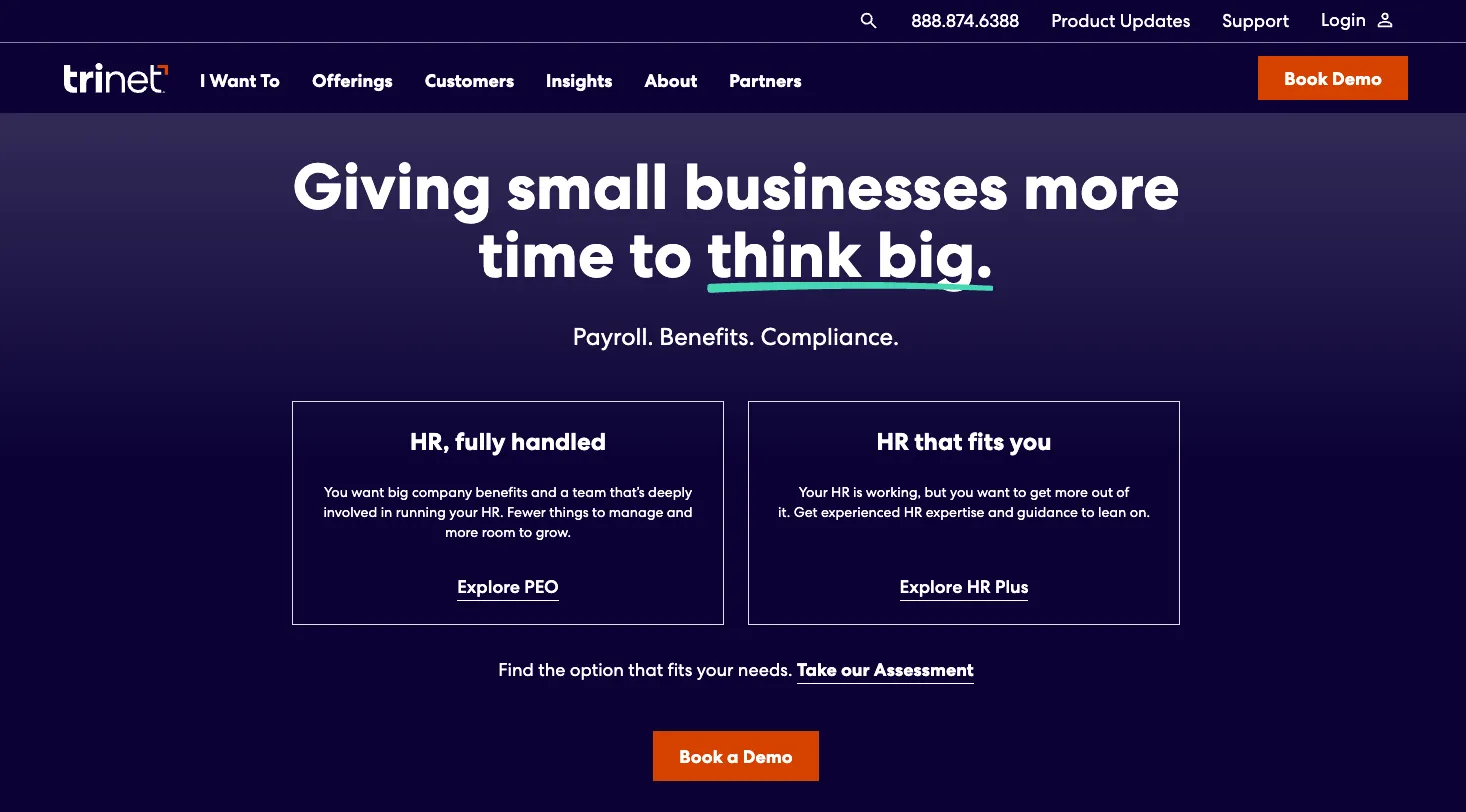
TriNet builds industry-specific benefits programs for approximately 340,000 employees, aligning plans to sectors like finance, life sciences, and tech rather than offering a single standardized package.
Pricing is only available via custom quote and some users report renewal increases that are hard to forecast year to year.
It’s typically a fit for mature small businesses in regulated industries where compliance and standardized benefits matter more than hands-on system control.
If you want to evaluate options beyond this provider, explore our breakdown of TriNet alternatives.
Is a PEO the Best Benefits Setup for Your Small Business?
Benefits are typically the second-largest cost for small businesses after salaries. A PEO simplifies how that cost gets administered, and for an early-stage team that simplicity is genuinely valuable.
However, if you are vetting whether these PEO services offer the best deal for your bottom line, it is important to understand the pros and cons of a PEO, particularly the trade-offs between administrative ease, pricing transparency, and the strategic benefits of consulting firms working directly on your behalf.
But is a simpler process the same as a better deal?
A PEO gives you a plan, but only a full-market audit tells you whether it's priced for your team. The good news is that you can do this without leaving your PEO. Before you decide whether your current setup is working, ask these questions:
Are You Getting the Right Rate for Your Team?
PEOs smooth pricing across many companies, so your renewal rate reflects the carrier's risk score for the whole pool, not your team alone, which hides what your workforce by itself should cost.
Meanwhile, brokers like Ignition Benefits bring that Risk Score into view before you go to market. When the risk score is low and the premium is high, there is negotiating leverage. That gap is where savings live.
What Does the Market Audit Cover?
Most PEOs show you options from their network while traditional brokers show you a curated shortlist from preferred carriers. Neither is a full-market audit because the difference between three plans and full-market access can be six figures.
You can't get that result on a plan that was never built around your team, exactly why Ignition Benefits runs a full-market audit at every renewal with no preferred carriers in the background.
If you are located in Georgia, see how an independent Georgia Employee Benefits Broker can help you benchmark your rates across every available carrier.
Stop Overpaying for Benefits. See What You Are Actually Paying For.
VC-backed and using benefits as a talent conversation? Sequoia One brings the analytics. Scaling across HR, IT, and Finance on one platform? Rippling might be the most capable option here.
Whatever PEO you are on, is your current benefits plan priced for your team, or is it priced for someone else?
For a 40-person company, the answer to that question is often worth $80K to $120K per year. That is one engineer or four months of runway.
Ignition Benefits focuses only on health benefits. It’s built for small companies already on a PEO or fully insured plan that feel their health insurance bill is too high, and want to reduce cost without changing doctors, coverage, or plan quality.
In just two calls, over 14 to 21 days, you can finally answer whether you are overpaying for health benefits and how much you could potentially save, at no cost to you.

.jpg)
.webp)

.webp)

.png)










_%20Which%20One%20Wins%20for%20Your%20Team_.webp)

![How to Reduce Small Business Health Insurance Costs [2026]](https://cdn.prod.website-files.com/69f22330e53a32bb7629af15/6aa04b2f5dbdf3dc6b28b351_How%20to%20Reduce%20Small%20Business%20Health%20Insurance%20Costs%20%5B2026%5D%20(1).webp)
.webp)




.webp)



.webp)

.webp)









.webp)













.webp)




.png)

