.svg)

.svg)

.webp)
.webp)

- Justworks and TriNet are Professional Employer Organizations (PEOs) that use a co-employment model to bundle payroll, employee benefits, HR, compliance, and workers' compensation into a single platform
- Choose Justworks if you're a startup, tech-forward SMB, or fast-growing company that wants transparent pricing, an intuitive platform, and enterprise-grade employee benefits without building an in-house HR function
- Choose TriNet if you're a professional services firm or midsized business in industries like technology, finance, legal, life sciences, or consulting that needs industry-specific HR expertise alongside enterprise-level benefits
- Consider Ignition Benefits alongside either PEO if you want to stop overpaying for employee benefits. It is the best employee benefits broker for founders and growing companies of up to 200 employees seeking transparent benefits advice and full-market plan comparisons
Choosing between Justworks and TriNet? Both are PEOs that help with workforce management, but aren't built for the same type of business.
Justworks works best for fast-growing startups, while TriNet suits businesses with more complex HR and compliance needs. Let's compare them across the areas that matter most to your decision below.
Justworks vs TriNet: At A Glance
Who Is Justworks Best For?
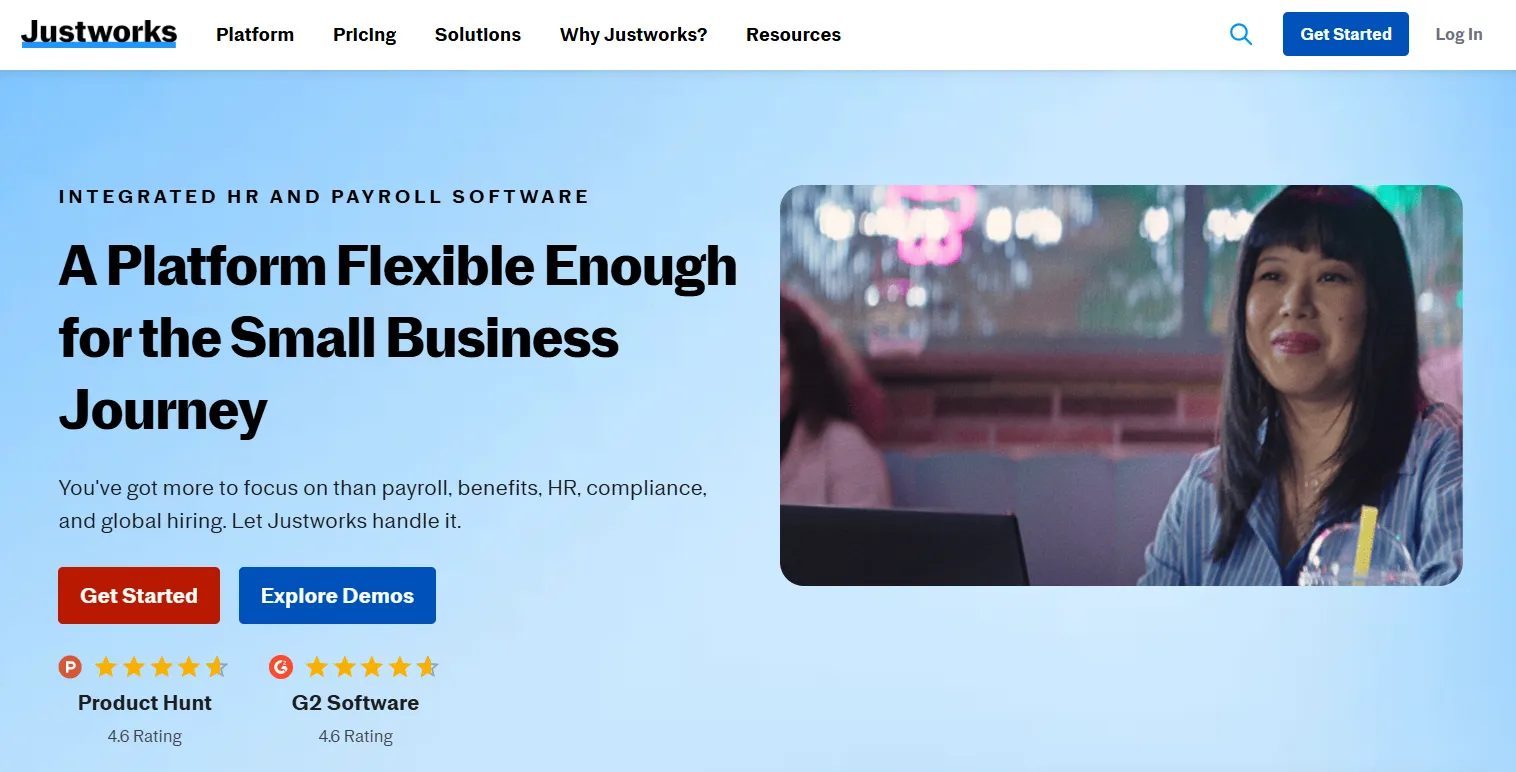
Founded in 2012, Justworks is a Certified PEO built for small businesses that want payroll, benefits, HR, and compliance in one self-serve platform. It's designed for:
- Founder-led teams without an HR hire: Run payroll, benefits admin, and 50-state compliance from one dashboard
- Small teams that want large-group benefits: Access medical, dental, and vision plans through national carriers
- Multi-state employers: Automated tax filings across 4,000+ tax localities, with W-2 and 1099 handling built-in
- Teams making their first international hires: Add EOR employees or pay international contractors without setting up a foreign entity
Who Is TriNet Best For?
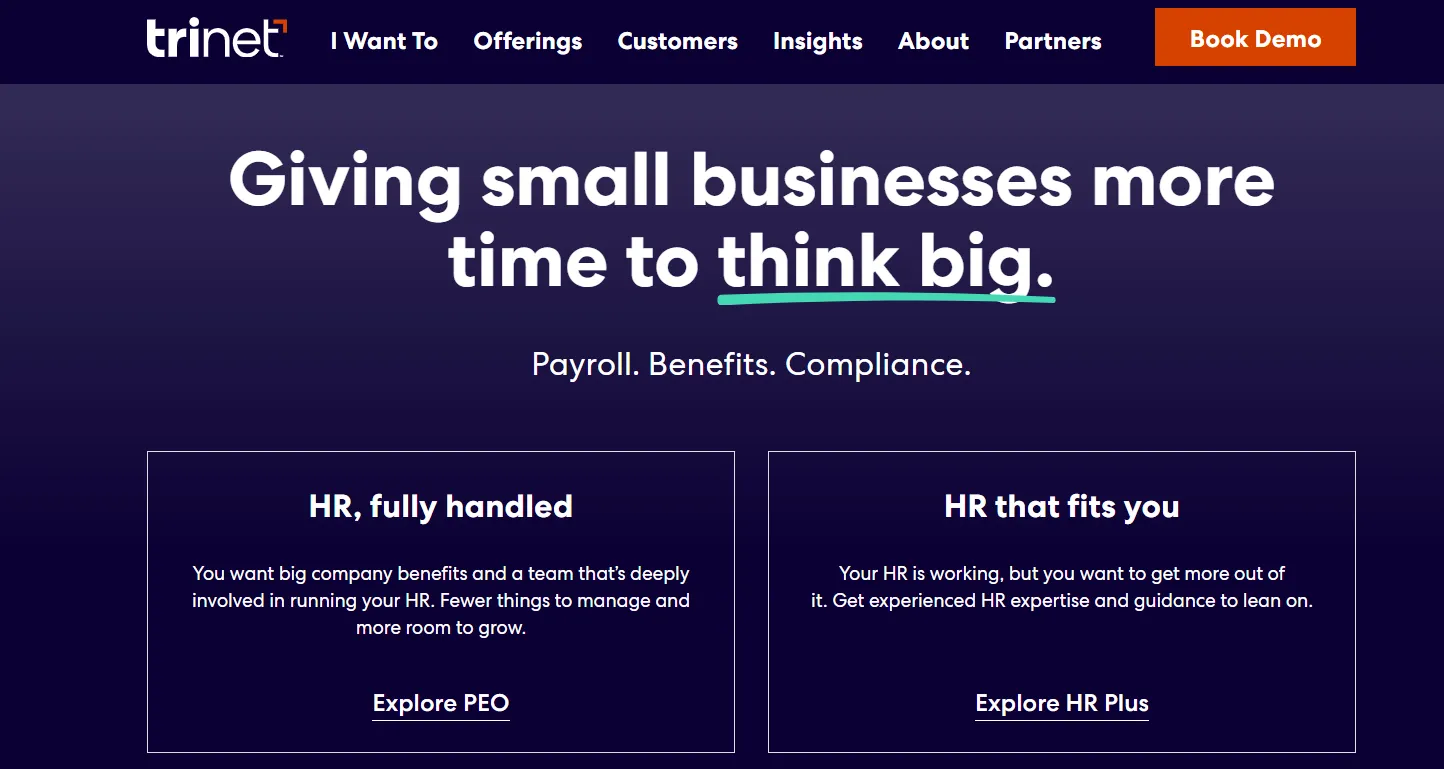
TriNet was founded in 1988 and is a publicly traded PEO built around industry-specific HR rather than a one-size-fits-all platform. It's designed for teams that want experts on call, including;
- Companies in specialized industries: Vertical PEO programs for technology, life sciences, financial services, nonprofits, professional services, hospitality, and retail, each with an industry-specialized HR team
- Teams that want big-company benefits: Plans through Aetna, Kaiser Permanente, UnitedHealthcare, MetLife, and Empower Retirement, plus the Enrich program for tax-optimized reimbursements
- Compliance-heavy businesses: Expert guidance on federal, state, and industry regulations, with workers' compensation, ACA, and OSHA support, and EPLI included
- Employers that prefer human support over self-serve: A dedicated relationship manager plus 24/7 access to HR experts through Connect 360
Ignition Benefits As an Alternative: For Teams That Need a Benefits Broker Alongside (or After) Your PEO
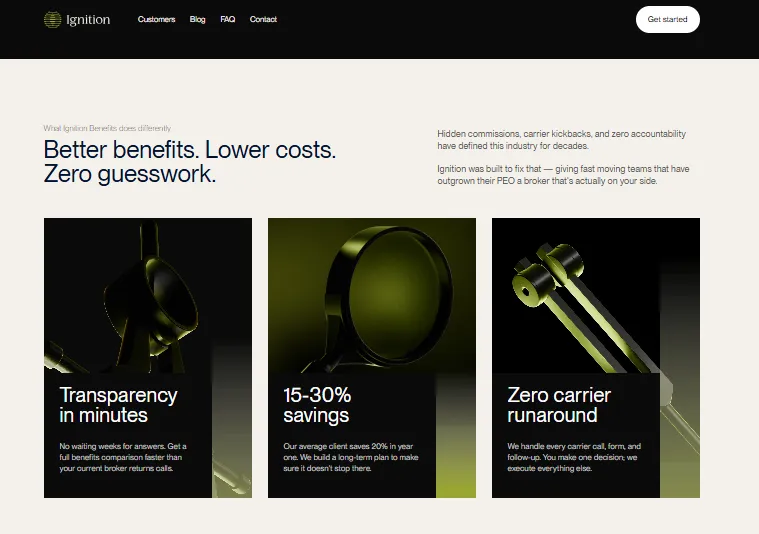
In a PEO like TriNet and Justworks, your employees sit in a pooled benefits plan. You never see the risk score behind your premium, and neither platform re-bids your plan against the open market.
That blind spot is why Ignition Benefits exists and why the PEO vs. benefits broker question keeps coming up.
Nick Taranto scaled Plated to 1,500 employees and overpaid on benefits for five straight years without noticing. So, he built Ignition Benefits for:
- Founders and teams of up to 200 employees that own the benefits decision and have never had their plan independently audited
- Teams approaching 50 employees on a PEO, where pool pricing starts working against a healthy workforce, and a PEO lift-out becomes worth pricing out
- Companies staying on Justworks or TriNet that want an independent read on whether the bundled benefits are competitively priced
- First HR hires who inherited an unexamined setup and need a defensible recommendation before renewal
Employee benefits are often the most expensive part of any PEO relationship. Before focusing on administration fees, compare how health benefits are priced. Ignition Benefits benchmarks your current plan against the wider market to help identify where you may be paying more than necessary.
Price
PEO administration alone averages $1,395/employee/year, so how each platform structures that fee decides what each PEO actually costs you.
Justworks
- Two published PEO tiers: PEO Basic at $79/employee/month and PEO Plus at $124/employee/month. A standalone Payroll plan runs $8/employee + $50 base
- What the sticker doesn't include: Health premiums and workers' comp coverage are billed separately, and add-ons stack: time tracking at $8/employee, international contractors at $39/month/paid contractor, EOR at $599/employee/month
- Predictability: Flat PEPM rates published on the site, no base fee on PEO tiers, month-to-month terms, so you can model costs before talking to sales
- Cost sentiment: On G2, a user cites "fair price," with their only gripe being they'd like more HR tools added
📖 Read Next: Weighing Justworks pricing against other platforms too? See how it stacks up in Deel vs Justworks for global hiring.
TriNet
- Quote-only PEPM model: No published rates; third-party estimates put full PEO service at $100–150/employee/month
- Watch the renewal, not just the quote: In SelectHub's analysis, nearly 80% of TriNet reviewers who mentioned price flagged annual cost jumps or overall expense
If these pricing risks are a concern, you can review our breakdown of the top TriNet alternatives to compare lower-cost options.
Verdict
On pricing alone, Justworks wins. You can model exact costs from published rates before talking to sales. TriNet isn't automatically pricier, but you can't fully comparison-shop before a demo call.
Employee Benefits
The right platform should help you offer competitive benefits, simplify administration, and reduce the time spent managing enrollments, compliance, and employee questions.
Justworks
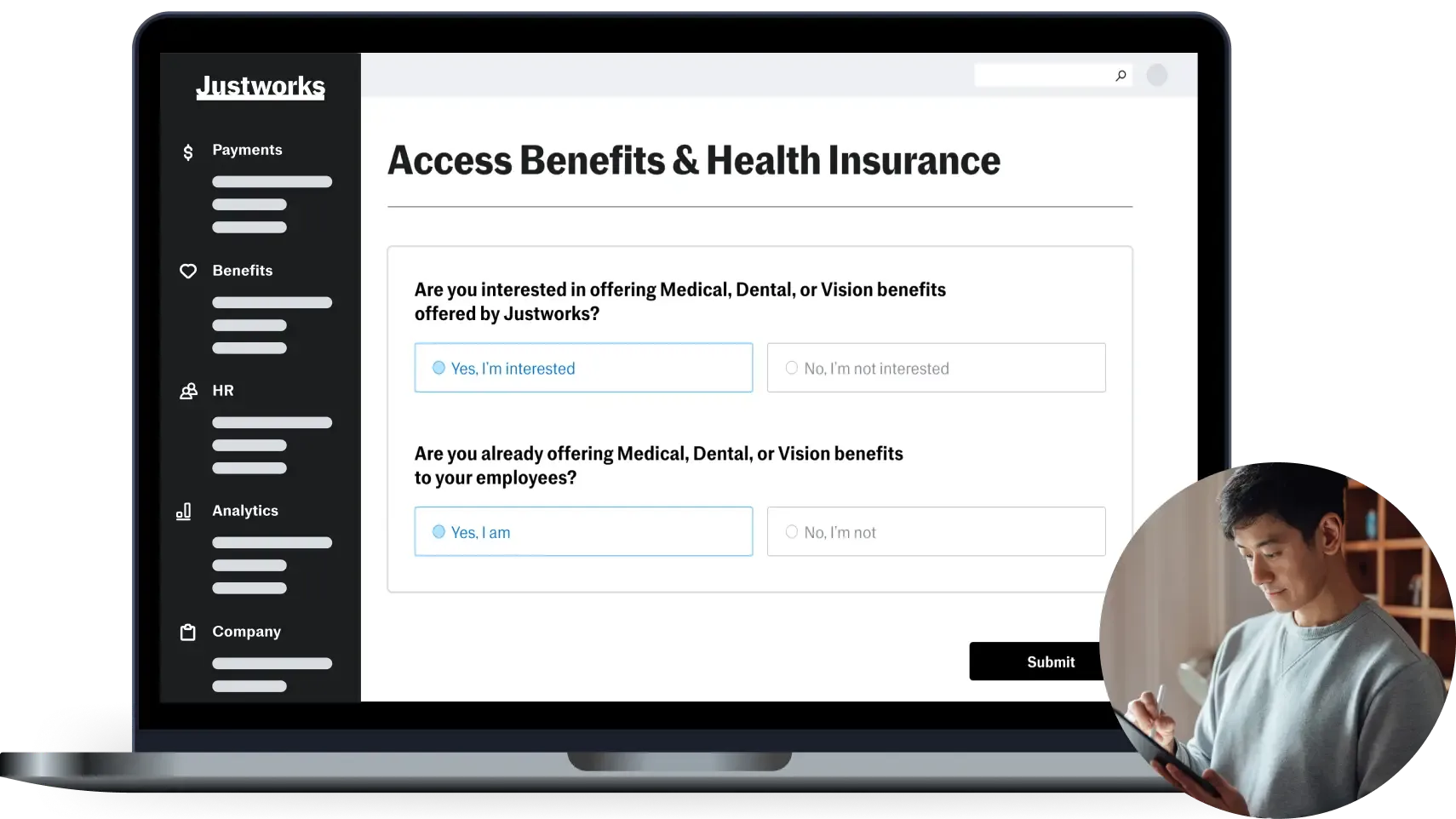
- Health coverage three ways: Small group, large group, and individual plans via ICHRA, with the option to transfer an existing plan
- National carriers on PEO Plus: Medical, dental, and vision through Aetna, Kaiser Permanente, MetLife, and UnitedHealthcare
- Financial benefits built in: 401(k) administration, HSA and FSA accounts, life and disability insurance, and commuter benefits
- Wellness perks at no added cost: Beyond health insurance, you can offer retirement plans, HSAs, FSAs, life and disability insurance, commuter benefits, and wellbeing perks such as Talkspace and One Medical
- Spend less time on administration. Justworks handles open enrollment, qualifying life events, COBRA, ACA requirements, HIPAA compliance, and payroll deductions
- On G2, a user calls Justworks’ benefits offerings "strong for a platform at this scale”
TriNet
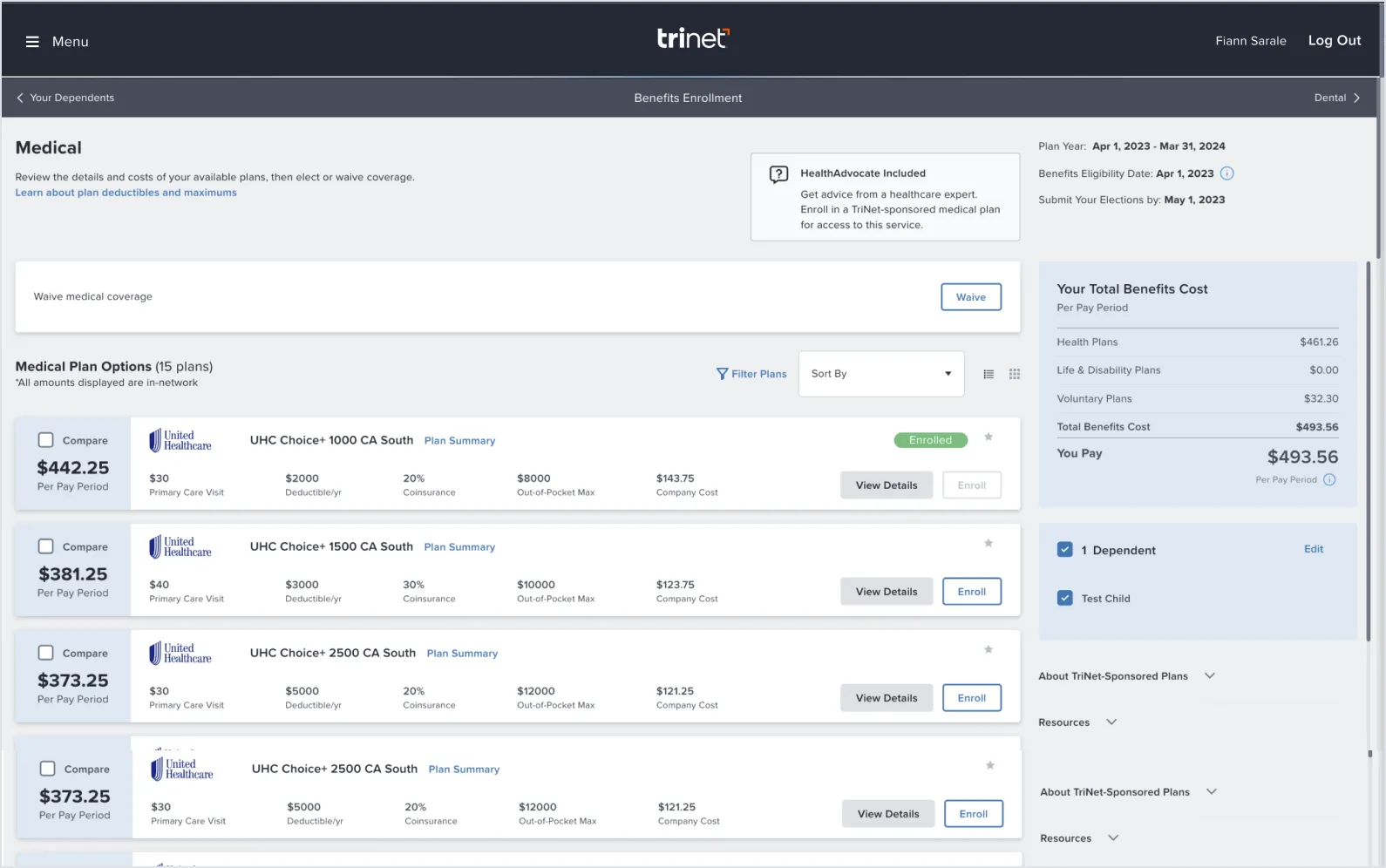
- Wider carrier bench, appreciated by reviewers: Medical, dental, and vision through Aetna, Blue Shield of California, Kaiser Permanente, UnitedHealth Group, MetLife, Aflac, and Highmark
- Retirement with fiduciary transfer: 401(k) through Empower with matching and profit-share options; TriNet takes plan administrator and primary fiduciary responsibility, including Form 5500 filings and plan testing
- Deep ancillary menu: HSA and reimbursement accounts, short-term and long-term disability, life with supplemental options, telemedicine, EAP, commuter benefits, and pet insurance
- Enrich and Perks programs: Tax-free travel reimbursements for medical care far from home, plus discounts with brands like Costco and Disneyland
- AI-assisted enrollment: A decision-support tool guides employees to coverage that fits their situation
Verdict
TriNet wins on breadth, especially more carriers, a deeper ancillary menu, and fiduciary transfer on retirement. Justworks wins on accessibility: the same class of national carriers, with the wellness stack included.
💡 Did You Know? Health insurance is the single biggest cost inside any benefits package, averaging $9,325/employee/year for single coverage. In a PEO, the premium is set by pool pricing, not your team's actual risk, which is why so many employers overpay without knowing. Ignition Benefits fixes that by pulling your Benefits Risk Score, auditing the full market, and negotiating the renewal, while you stay on whichever PEO service you choose.
See how PEO alternatives can give you more benefits cost control.
Payroll
Payroll is the operational core of any PEO relationship, and both platforms handle it; the difference is how much runs self-serve versus through a dedicated specialist.
Justworks
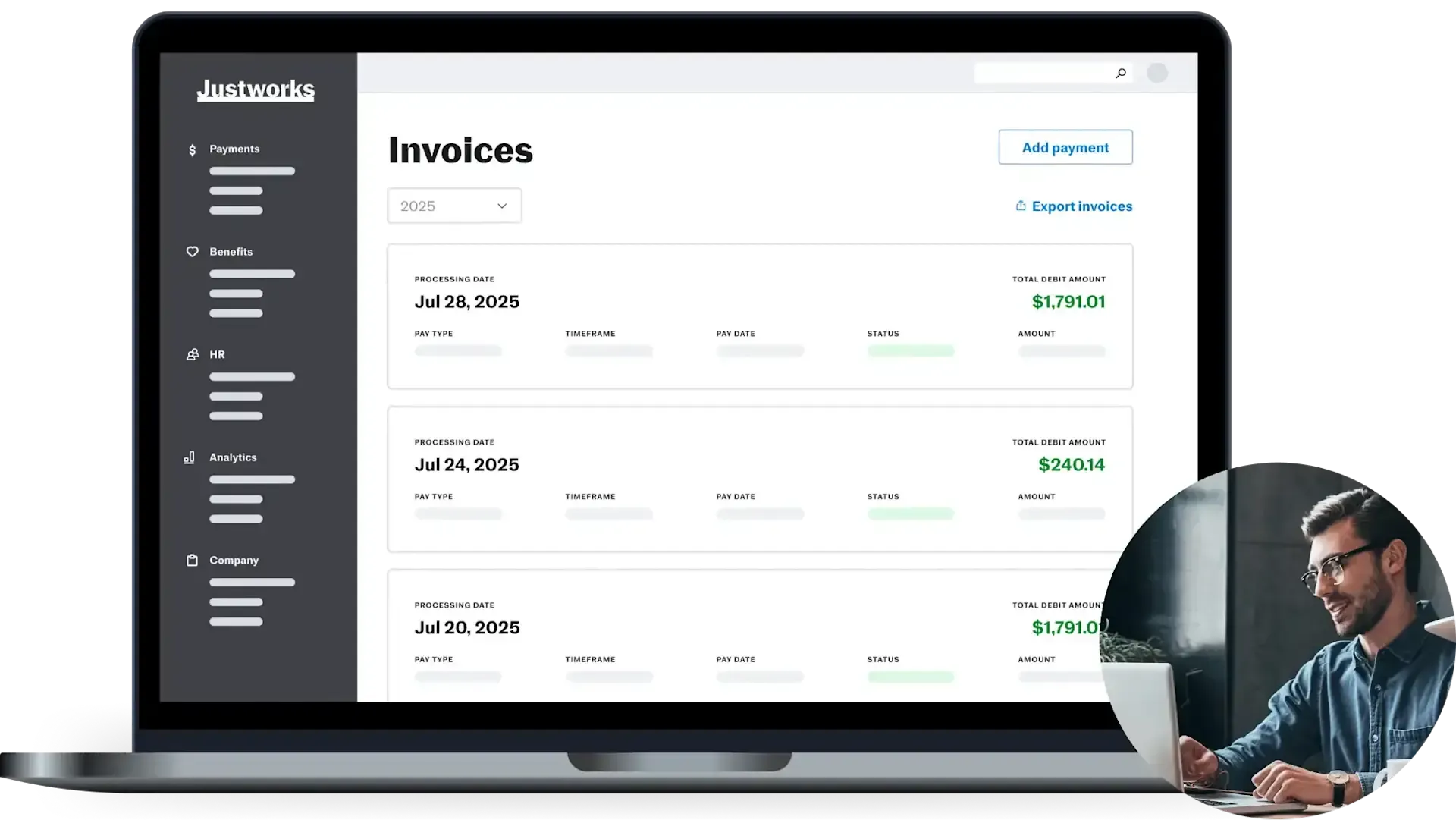
- Automated payroll on a set rhythm: Weekly, bi-weekly, or semimonthly runs with pay reminders and direct deposit in all 50 states, plus one-off payments for bonuses, vendors, contractors, and expense reimbursements.
- Still, this user laments the removal of a payment calendar, which they say used to be “good”
- Filings handled at no extra charge: Withholding, reporting, and filings for 940s, 941s, W-2s, and 1099s, plus state withholding and unemployment filings
- Accounting sync on every plan: QuickBooks Online and Xero on Payroll, with NetSuite and Sage Intacct added for PEO customers alongside built-in expense management
TriNet
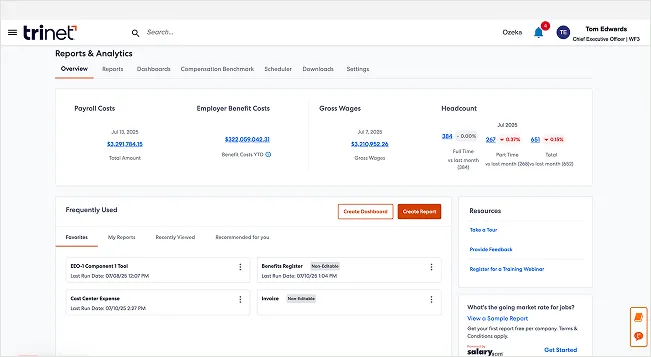
- A dedicated payroll specialist: An assigned contact who reviews pay runs and supports accuracy, rather than chat-first self-serve
- Connected payroll administration: Benefit deductions, time and attendance, and expense changes flow into each run automatically, with QuickBooks Online sync for the general ledger
- Tax compliance with expert backup: Automated calculations and filings for payroll processed on the platform, with payroll tax specialists on call
- Mobile approvals and reporting: Review and approve pay runs from the app, with on-demand reports, data visualizations, and total compensation statements
- Clarissa B switched from Justworks to TriNet and shares that “TriNet makes payroll seamless”
Verdict
Justworks suits teams that want payroll to run itself, with support available when needed. TriNet fits companies that want an assigned specialist to review runs.
HR Services
HR tools are why teams stay on a PEO after payroll becomes routine: onboarding, PTO, documents, and someone to call when an employee situation gets complicated.
Justworks
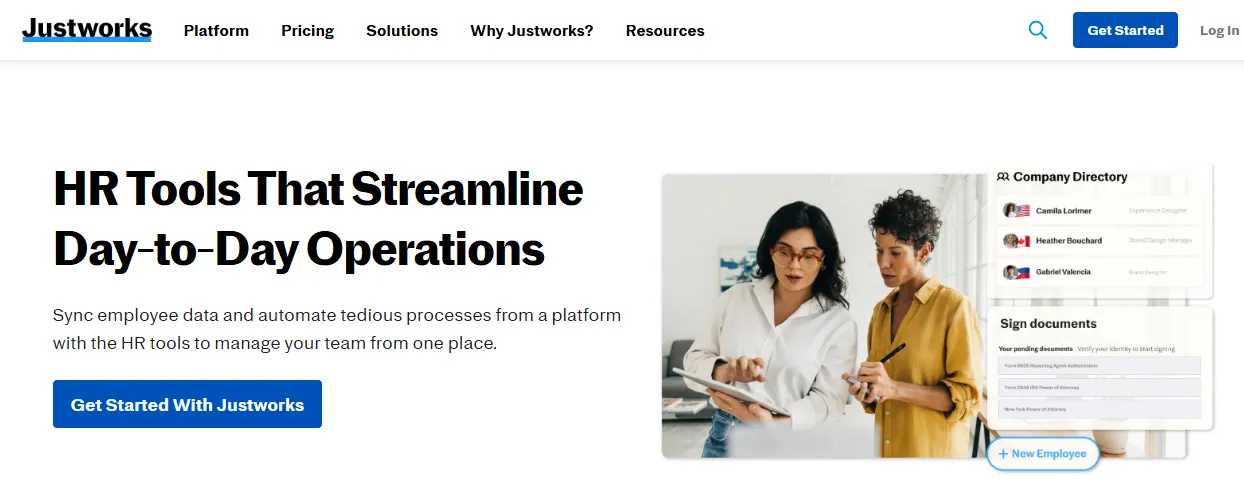
- Self-service onboarding: New hires set up direct deposit, pick health insurance, and e-sign documents step-by-step without admin hand-holding
- PTO and document management: Custom time-off policies by team or subset, real-time balance tracking with PTO reports down to the dollar, plus a document center with e-signatures and automated reminders
- HR guidance on two tiers: Standard HR consulting and Mineral's state-specific resources included with PEO, with dedicated HR consulting available as an add-on. Mindy S adds that Justworks makes HR “simple and easy”
- Team visibility tools: Company directory, org chart, calendar, third-party permissions for accountants or legal counsel, and ATS integrations with Greenhouse, Lever, and JazzHR
📖 Read Next: Wishing Justworks went deeper on HR tools is one of the most common reasons teams shop around. See the best Justworks alternatives compared on pricing, flexibility, and benefits before you commit.
TriNet
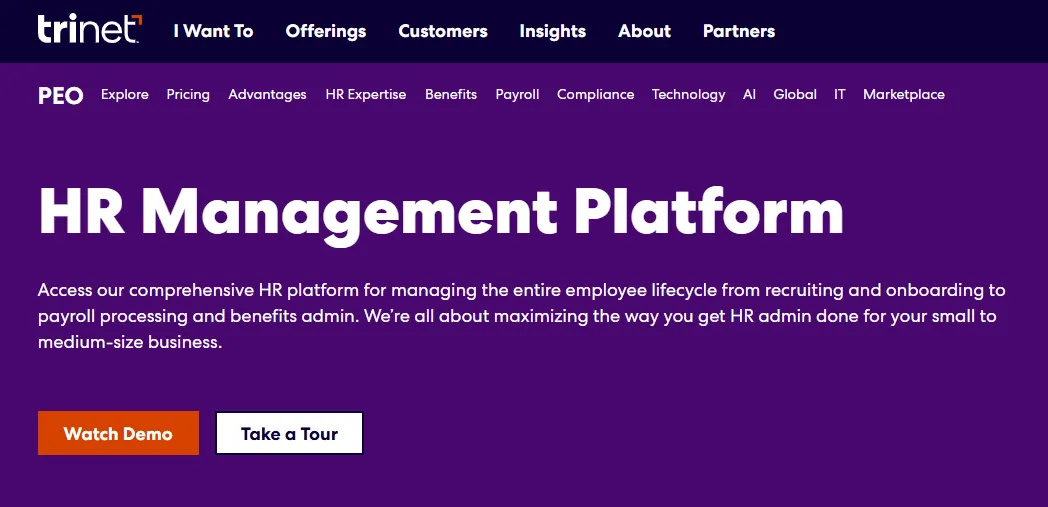
- Full-lifecycle HR platform: You get applicant tracking with job-board posting, onboarding, performance management with goals and feedback, AI-powered learning management, document management, and time and attendance in one login
- Reports and analytics on demand: Dashboards, visualizations, and pre-built or custom reports from your people data, plus total compensation statements
- AI-powered self-service: Employees get HR answers, view pay, request time off, and complete routine tasks on desktop or mobile without looping in admins
Verdict
Teams planning to stay lean get more from TriNet's model, while those that will hire People Ops in-house anyway only need Justworks' foundation.
Compliance
Compliance is the risk you're actually outsourcing with a PEO: payroll taxes, benefits regulations, workers' comp, and the employment claims that can sink a small company.
Here's what each platform takes off your plate.
Justworks
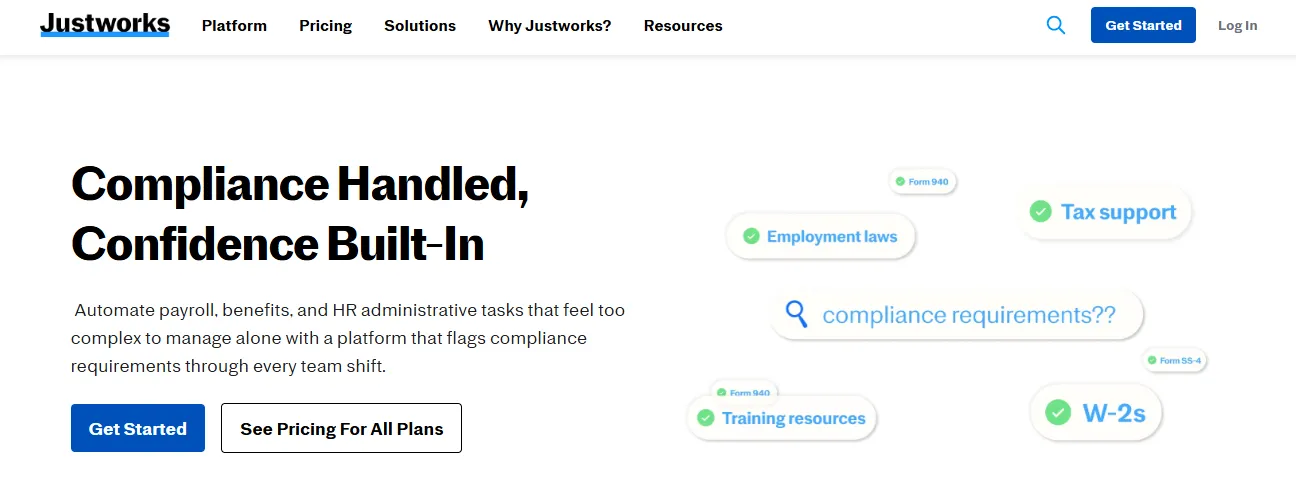
- Payroll tax filings automated: Withholding, reporting, and remitting for US and international employees, plus W-2, W-3, 1099, and 940/941 filings, with IRS-certified PEO status and ESAC accreditation adding operational safeguards
- Workplace insurance centralized: Workers' comp under a master policy, state unemployment insurance, and EPLI coverage, with in-house UI appeals and hearings support
- Compliance that scales with the team: Automated reminders and built-in guidance as you expand across states, covering state tax registration, ACA and COBRA filings, and benefits enrollment
- Free training and resources on PEO: Sexual harassment prevention and DEIB training online, Mineral's employee handbook builder, and digital I-9 and poster compliance through Discern
TriNet
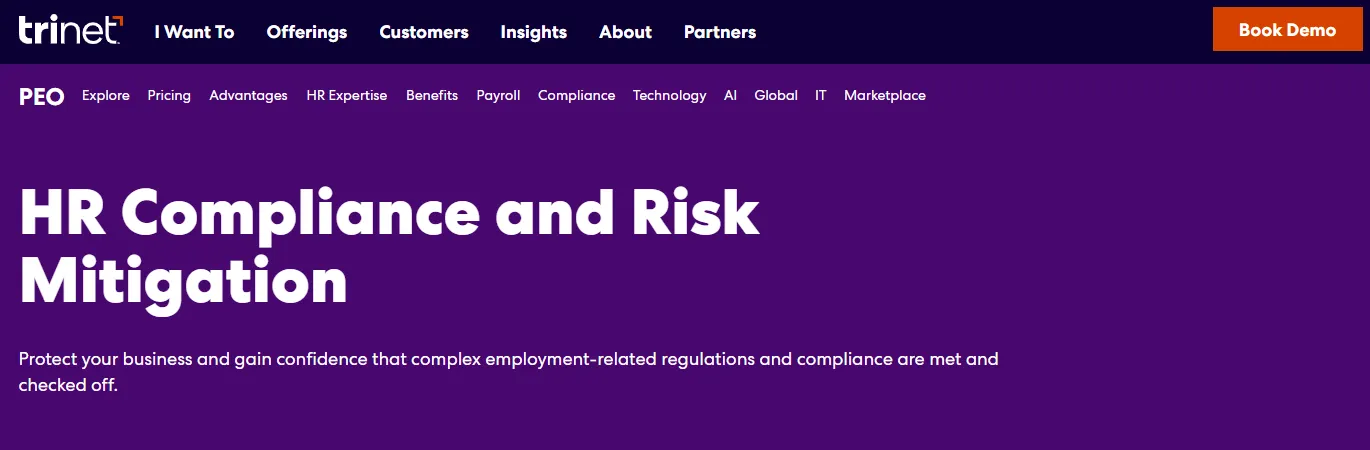
- Employment practices risk management: Claims prevention resources, active claims mitigation with pre-negotiated external counsel fees, and EPLI coverage backed by an internal claims team
- Benefits compliance with delegated responsibility: TriNet takes administrative responsibility for health plans and fiduciary responsibility for retirement plans, covering Form 5500 filings, plan testing, COBRA, and an integrated ACA solution
- Payroll compliance across jurisdictions: Federal, state, and local collection and remittance, W-2 creation with TurboTax integration, and unemployment claims administration
- Workers' comp with safety expertise: Pay-as-you-go plans with no deposits or deductibles, an experienced claims team, and workplace hazard assessments against industry standards
- On TrustRadius, Krystyna Hales says TriNet keeps her team compliant across employment laws by state, as they run a remote team
Verdict
Pick Justworks if your compliance risk is mostly administrative. Or, TriNet if your risk includes people problems, since claims prevention, managed litigation exposure, and fiduciary transfer matter more in regulated industries and at headcounts where employment claims get likelier.
How to Choose the Right PEO for Your Business
Justworks and TriNet both clear the fundamentals, so the decision comes down to how each model fits your team. Three criteria to consider:
Total Cost, Including What the Quote Doesn't Show
Apart from the PEPM fees disclosed upfront, look into hidden fees such as health premiums billed separately, add-ons, and renewal increases you can't predict from a quote. Ask for the full fee schedule and a year's average renewal increase before signing.
If you need a broker alongside or instead of PEO, Ignition Benefits charges $0 in employer fees and gets paid through standard carrier commissions.
Your HR and Benefits Needs
For many teams, payroll and compliance are table stakes, but employee benefits tend to get expensive quite fast.
Pairing your PEO with an independent benefits broker like Ignition guarantees better health benefits priced on your team's actual risk.
📖 Read Next: Overcharging on health benefits usually results from how the plan is funded: see level-funded vs self-funded to learn which structure returns unused premiums at year-end.
Freedom to Leave When the Math Changes
PEO economics shift as you grow, so evaluate the exit before you enter. Check contract terms, notice periods, and what happens to coverage when you leave a PEO.
Ignition Benefits specializes in that transition: a PEO Lift-Out managed end-to-end, with a transition checklist covering timing, carrier submissions, and re-enrollment with no coverage gaps.
Alternative to a PEO: Ignition Benefits for Companies That Want to Stop Overpaying on Benefits

Ignition Benefits is a benefits brokerage with no carrier allegiance, created for business leaders who want to stop overpaying on benefits.
While Justworks and TriNet keep running payroll, HR, and compliance, Ignition takes over the line item neither one audits: whether your health premium is priced on your team's actual risk.
Ignition Benefits Key Features
Ignition's engagement runs on three capabilities that a bundled PEO plan structurally can't offer.
Benefits Risk Score
Carriers already have a risk score on your team, which sets the price of every renewal quote you receive. However, employers are not privy to the details.
Ignition pulls the actual score for your team before going to market. If you have a young, healthy team, you should score low. If the score is low but the premium is high, you're overpaying with the proof in hand.
Full Market Audit and Renewal Negotiation
Ignition checks every available carrier, plan, and funding structure (fully insured, level-funded, self-insured) against your actual workforce data at every renewal.
In a PEO, that audit does not happen often, so the fully-insured plan is the only option on the table.
PEO Lift-Out
At 50 employees, a healthy team increasingly subsidizes higher-risk companies in the pool, and the math starts working against you.
Ignition Benefits replaces pool pricing with a plan built on your actual workforce. The transition is managed end-to-end, covering timing, carrier submissions, and re-enrollment with no coverage gaps.
The trigger document is a single Broker of Record letter, and your payroll platform stays exactly where it is.
Ignition Benefits Pricing
Ignition Benefits doesn't charge employers a direct fee. Instead, it's compensated through standard carrier commissions, with full commission disclosure from day one.
Where Ignition Benefits Shines
- Total time asked of you: 30 minutes. Two 15-minute calls. Call one is intake: census, current plan, premiums. Ignition runs the analysis in 14 to 21 days. Call two is the review: you walk through the Benefits Analysis Report and leave with one document to sign
- Transparency on every health plan option: you see the full market side by side, with Ignition's commission on each plan disclosed
- Your stack doesn't move. Ignition works alongside Justworks and TriNet, not instead of them
Where Ignition Benefits Falls Short
- It's a brokerage, not an HR platform. Ignition won't run payroll, onboarding, or PTO. You still need Justworks, TriNet, or another platform like Deel and Insperity for the operational layer
Ignition Benefits Customer Reviews
Robert McConchie, CFO and Co-Founder at AWM Capital:
"We assumed Gusto was getting us a fair deal on benefits. Two short calls with Ignition saved us six figures and got us better coverage than we'd ever had."
Nick Mares, CEO at Light Labs:
“I didn't realize how much money we were leaving on the table until Ignition ran the numbers. We saved $113,000 in year one, on a 25-person team. For a company our size, that makes a big difference.”
Who Ignition Benefits Is Best For
- Founders and CFOs on Justworks or TriNet approaching 50 employees: the point where pool pricing turns against a healthy workforce, whether that means a PEO Lift-Out or an independent read on what the bundled benefits should cost
📖 Read Next: See how Ignition Benefits compares to the best PEOs for health insurance before your next renewal decision.
Justworks, TriNet, or Neither?
Justworks is the better fit for founder-led teams that value transparent pricing and a modern self-service platform. TriNet makes more sense for companies that need industry-specific HR expertise alongside payroll, compliance, and employee benefits.
However, neither platform independently evaluates whether your health plan is competitively priced. If employee benefits have become one of your largest operating costs, or you're approaching the point where a PEO no longer offers the best value, it may be time to compare your options beyond the bundled plan.
Ignition Benefits works alongside Justworks and TriNet to benchmark your current benefits against the wider market, helping you understand what your health coverage should cost before your next renewal.
FAQs
How are PEO health plans structured?
PEO health plans run on a master policy. The PEO sponsors one large-group plan, pools employees from all its client companies into a single risk group, and your team enrolls under that umbrella.
Why do PEO health plans get expensive as you grow?
Because pool pricing averages everyone together. A young, healthy team pays rates that reflect the pool's overall risk, effectively subsidizing higher-risk companies in it, and that gap widens as headcount grows. Near 50 employees, your own group is often large enough to get better rates on the open market.
Does working with a benefits broker cost extra on top of a PEO?
No. Employee benefits brokers like Ignition Benefits are paid through standard carrier commissions, so there's no employer fee for auditing or negotiating your plan.



_%20Which%20One%20Wins%20for%20Your%20Team_.webp)

![How to Reduce Small Business Health Insurance Costs [2026]](https://cdn.prod.website-files.com/69f22330e53a32bb7629af15/6aa04b2f5dbdf3dc6b28b351_How%20to%20Reduce%20Small%20Business%20Health%20Insurance%20Costs%20%5B2026%5D%20(1).webp)
.webp)




.webp)




.webp)









.webp)





.webp)








.webp)




.png)

