.svg)

.svg)

.webp)
.webp)

- Among business leaders who could name their health insurance renewal number, 39% took a double-digit premium increase. The average hike was 7%.
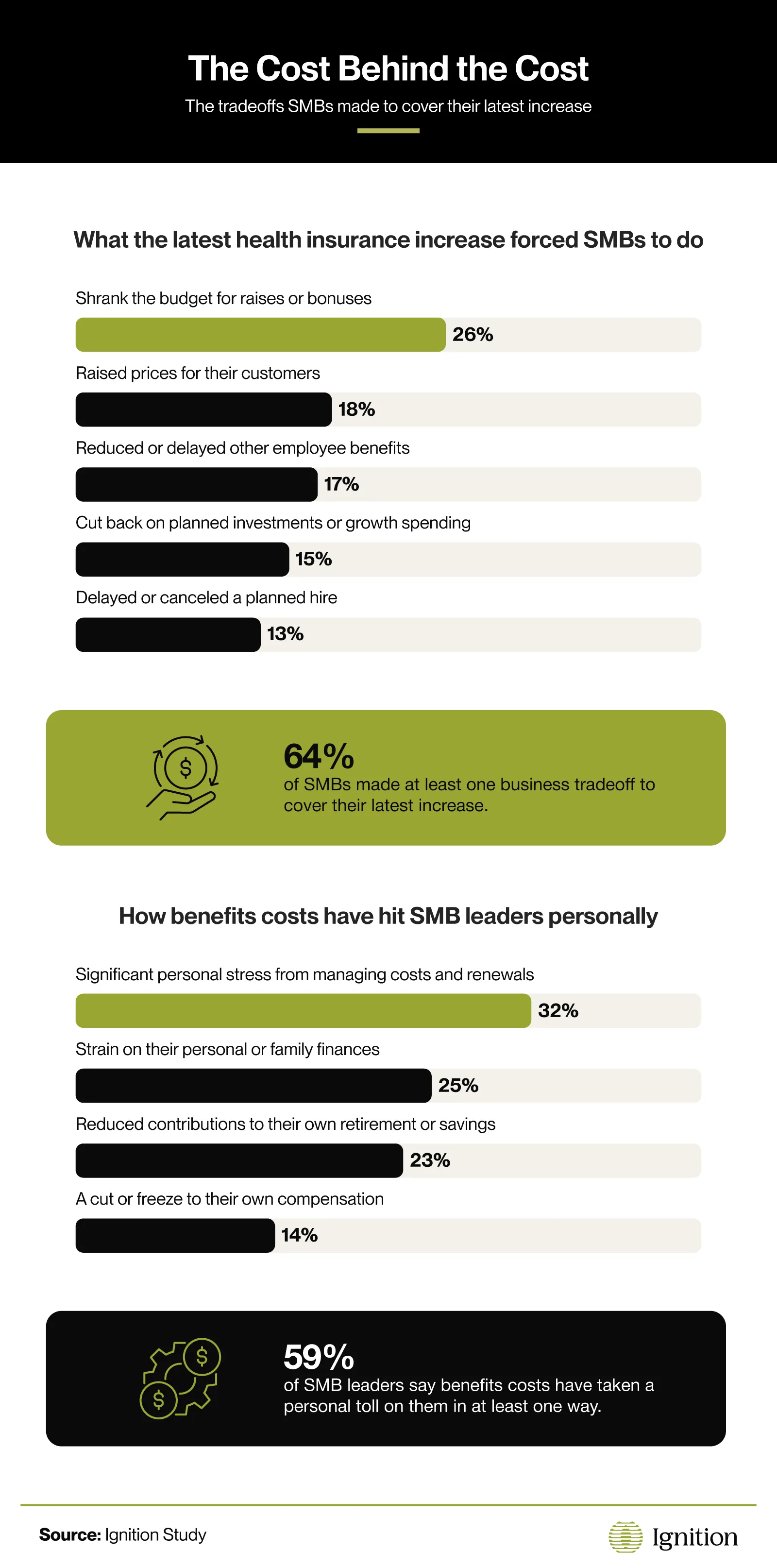
- In order to cover a health insurance cost increase, 64% of business leaders reported having to sacrifice something else. The most common casualty was the raise and bonus budget (26%).
- Benefits costs have hit 59% of business leaders personally, through stress, their own retirement contributions, or a freeze on their own pay.
- Only 31% of business leaders received a clear breakdown of what was driving their cost increase.
- Nearly half of business leaders (49%) believe they have been overcharged for coverage. Only 17% feel sure enough to say so.
- 38% of the business leaders who could say how many quotes they compared had looked at two or fewer.
- 48% of business leaders ended up paying at or close to the first number their insurer put in front of them.
- 41% of business leaders assume their broker already finds them savings. Only 6% have ever verified it.
- 53% of business leaders say rising healthcare costs have made it harder to compete for talent.
What small companies are really paying for healthcare: 2026 report
Most small business leaders can tell you exactly what their health plan costs. Far fewer can tell you why it costs that.
Ignition Benefits surveyed 503 leaders at U.S. companies with 10 to 250 employees about their most recent health insurance renewal. We asked what their broker or carrier told them, how many options they compared, what they gave up to cover the increase, and whether they thought the price was fair. The answers describe a purchase made largely in the dark.
Two-thirds of companies gave something up to pay for their last increase. Nearly half paid the first number they were handed. And only 6% have ever checked whether they were overpaying in the first place.
The renewal letter arrived without a reason attached
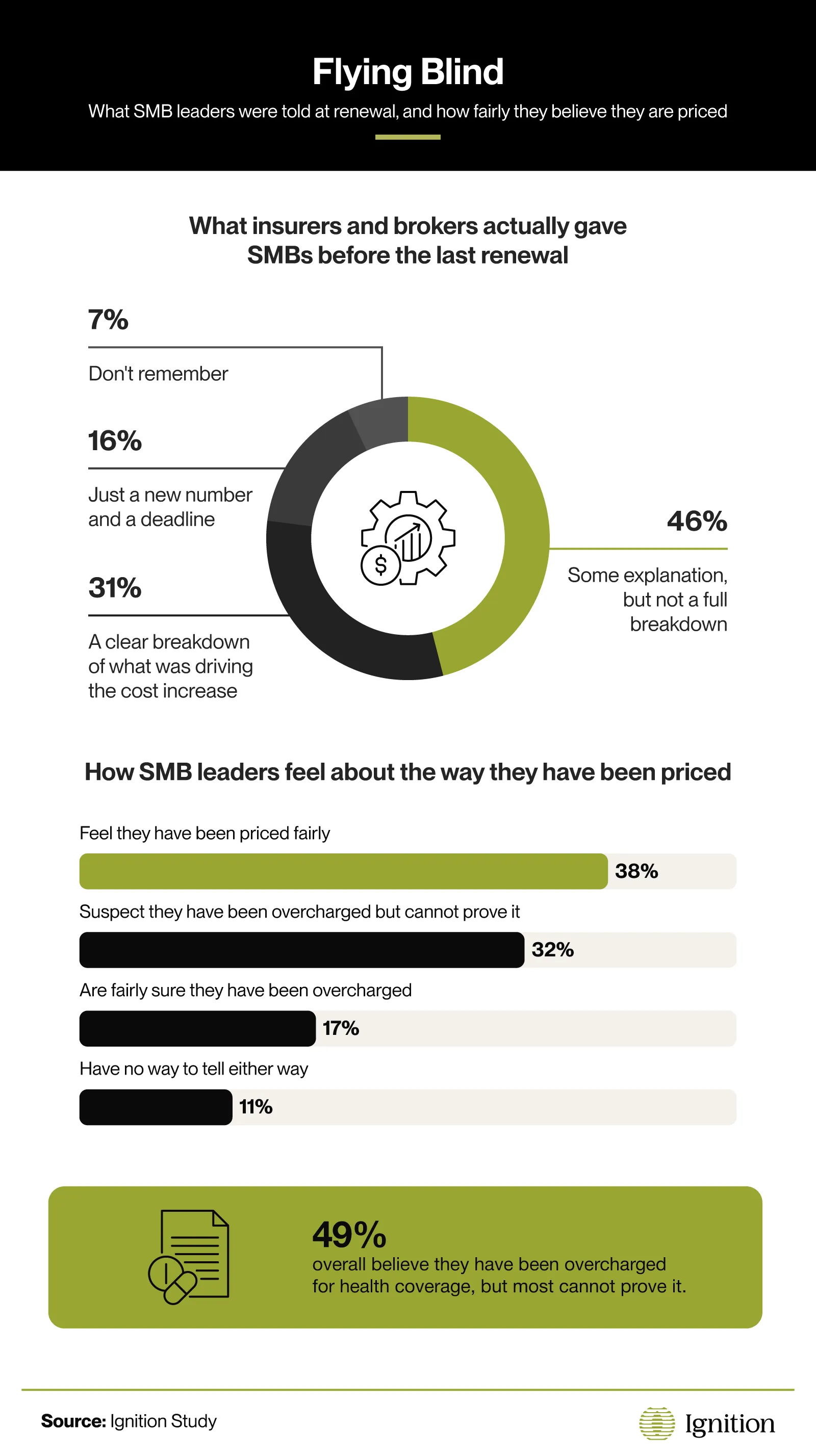
Roughly a third of companies got a real explanation for their new premium. The rest got something vague, or nothing at all: 46% received some explanation but not a full breakdown, and 16% were handed a new number and a deadline. Another 7% could not remember what they were told.
That gap in information shows up as doubt. Only 38% of leaders feel they have been priced fairly. Almost half (47%) are not confident their company is paying the right price right now, and 11% say they have no way to tell either way. The suspicion is widespread, but very few leaders have the documentation to act on it.
Somebody paid for the increase, and it usually wasn't the insurer
When premiums went up, the money came out of the business. Companies shrank raise and bonus budgets (26%), raised prices for their own customers (18%), trimmed other employee benefits (17%), and delayed or canceled planned hires (13%).
Leaders absorbed part of it themselves. About a third (32%) reported significant personal stress from managing costs and renewals, a quarter said it strained their household finances, 23% reduced contributions to their own retirement, and 14% took a cut or freeze to their own compensation.
And when costs spike, 48% of companies default to moving the burden onto employees through premium sharing, higher deductibles, or coverage cuts. Only 27% absorb it to protect their team.
See the full breakdown of tradeoffs by industry, region, and benefits setup
The GLP-1 line item most employers can't see
Drugs like Ozempic and Wegovy have become a renewal question most companies cannot answer. Among the SMBs whose plans cover GLP-1s, 58% cannot say what that coverage adds to their costs. It is buried in pharmacy spend, or they simply have no idea. Only 11% know the specific amount.
Employees are already asking. More than a third of all companies surveyed (35%) said staff have requested GLP-1 coverage, and some have already lost people over the answer. The full report covers what employers covering GLP-1s said they would do if GLP-1s pushed their next renewal up another 6% to 14%, and it is not a comfortable number.
Why so few companies check
The main thing standing between these companies and lower premiums is not price, rather an assumption made. When we asked leaders why they had never checked whether they were overpaying, the top answer was that they assume their broker already handles it (41%). A third (33%) did not know a review was possible. A quarter feel locked in until the next renewal.
Lack of time came near the bottom of the list at 16%, which is telling. A review takes about fifteen minutes. Only 6% of companies have run one.
Awareness of the alternatives is thin too. About 1 in 5 leaders (19%) are unfamiliar with ICHRA, level-funded, or self-funded models, and 30% have never considered switching to one. Exploring various health insurance alternatives for small business models can help employers evaluate options beyond traditional fully insured coverage.
See how to reduce small business health insurance costs before your next renewal.
What's inside the full report
The complete study runs 16 pages with every chart and the full demographic cuts. It includes:
- Average annual premium cost per employee by region, including the $2,652 gap between the most and least expensive parts of the country
- What traditional fully insured plans cost compared with level-funded and self-funded ones
- How renewals differed for companies on a PEO versus those working directly with a carrier or broker
- What covering employers said they would do if GLP-1 costs drove the next renewal up another 6% to 14%
- The 11 benefits leaders say employees now expect, ranked, and the share of leaders who admit their plan does not meet employee needs
- Where current plans fall short of what employees actually need, in leaders' own assessment
- Full cuts by industry, region, company role, generation, and benefits setup
Request your copy of The Benefits Blind Spot
Methodology
Ignition Benefits surveyed 503 leaders at U.S. small and mid-sized businesses with 10 to 250 employees between July 2 and July 16, 2026. Respondents were screened for a company leadership role. The sample included owners and founders (10%), C-level executives (14%), vice presidents (6%), directors (31%), managers (33%), and HR, finance, or operations specialists (6%). Respondents were 51% women and 49% men. Generationally, 11% were Gen Z, 52% were millennials, 31% were Gen X, and 6% were baby boomers.
About Ignition Benefits
Ignition Benefits is an employee benefits brokerage built for startups and high-growth companies with up to 500 employees. We use anonymized employee health data to expose overpayment and negotiate better rates, saving clients an average of 20% in the first year. Ignition handles the process end to end, from carrier calls and paperwork through enrollment and ongoing account management. You get plan design tailored to your workforce, hands-on support through open enrollment and renewals, and clear pricing with no long-term contracts.
Fair use statement: The findings and graphics in this study may be shared for noncommercial purposes. If you use them, please link back to Ignition Benefits so readers can see the full research.



_%20Which%20One%20Wins%20for%20Your%20Team_.webp)

![How to Reduce Small Business Health Insurance Costs [2026]](https://cdn.prod.website-files.com/69f22330e53a32bb7629af15/6aa04b2f5dbdf3dc6b28b351_How%20to%20Reduce%20Small%20Business%20Health%20Insurance%20Costs%20%5B2026%5D%20(1).webp)
.webp)







.webp)

.webp)









.webp)





.webp)








.webp)




.png)

