.svg)

.svg)


.webp)

- Deel operates on a modular pricing model, where each service is priced individually.
- Deel EOR starts at $599/employee/month, US PEO at $125/employee/month, US Payroll at $29/employee/month, and HR at $5/employee/month.
- Deel's biggest strengths are global reach, hiring speed, and an integrated platform that handles payroll, HR, IT, and benefits in one place.
- The main drawbacks are PEO pool pricing that can work against healthier teams, EOR costs that get expensive at scale, and platform performance issues flagged across user reviews.
- If your team is US-based and health benefits cost is the core problem, Deel's PEO gives you plan access, but no independent market audit. Ignition Benefits runs that audit at no cost to the employer, reviewing all carriers, plans, and funding structures to identify cost-competitive health coverage.
Most founders searching for "Deel pricing" expect a single number, yet there isn't one.
Because Deel operates as a modular platform, the total cost depends on the services you choose. You pay separately for EOR, PEO, payroll, HR, and IT management, and each service comes with its own basic fee and add-ons.
Below is the full breakdown of how much Deel costs, including pricing by product, benefits, drawbacks, and whether it's worth the investment.
How Much Does Deel Cost?
Ignition Benefits: An Alternative

If you're considering Deel for health insurance, chances are you're either setting up coverage for the first time and want someone to shop the market on your behalf, or you're tired of premiums rising every year with no explanation. Those are exactly the problems Ignition Benefits was built to solve.
Ignition is an employee benefits brokerage built for founders who want the best quality healthcare for their workforce without overpaying for it.
Here's how it differs from Deel's PEO:
- Benefits Risk Score visibility: Before going to market, Ignition shares the Benefits Risk Score that every carrier already has on your workforce - which Deel and most PEOs don't show. If your team is young and healthy and that score is low, you're likely overpaying. Ignition uses that gap to negotiate a better deal.
- Full-market audit: At every renewal, Ignition runs a full-market audit. Every carrier, funding structure, and plan is weighed out, and a clear recommendation is given.
- No employer fee: Ignition is compensated through standard carrier commissions, the same model as every other broker. Employers pay nothing out of pocket.
Side Note: If you like Deel for HR and payroll but want the level of transparency Ignition brings to health benefits, you don’t have to choose one over the other. Deel allows companies to work with their own broker, while it handles the admin through its platform.
Get your Benefits Analysis from Ignition →
Deel Pricing Plans: A Breakdown
Here’s a closer look at what Deel’s most popular products cost and what you get for that price.
1. US PEO - $125/Employee/Month
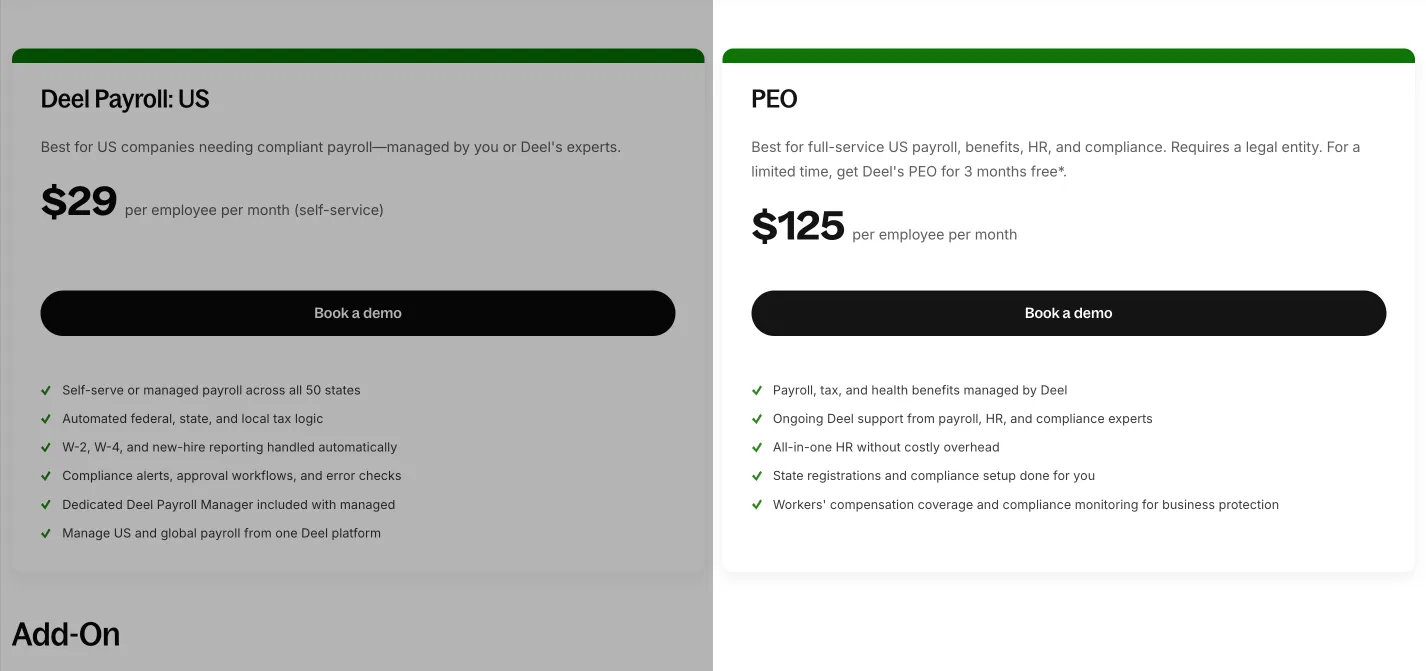
Deel's US PEO operates as a co-employment arrangement that supports businesses in all 50 states. Under this model, Deel takes care of payroll, tax filings, compliance, and benefits administration, while the company remains responsible for managing employees day to day.
What's included:
- Federal, state, and local tax filings
- Access to national health plans from Aetna and Kaiser Permanente
- Dental, vision, 401(k), HSA/FSA, and supplemental benefits
- Workers' compensation and EPLI coverage (a type of coverage that protects businesses against employee-related claims such as wrongful termination)
- Dedicated HR Business Partner
- Onboarding localized by state
One thing to keep in mind with Deel's PEO is how benefits pricing works. Your company joins a larger pool of Deel PEO customers, so rates are based on the overall risk profile of that group rather than your workforce alone. For startups with younger, healthier teams, that can mean paying more than they would under a standalone benefits plan.
2. Employer of Record (EOR) - From $599/Employee/Month
.webp)
For companies expanding globally, Deel's EOR removes the need to set up local entities before hiring. Deel takes on the role of legal employer, overseeing employment contracts, local payroll, tax compliance, and country-specific benefits requirements.
According to its website, Deel is available in 130+ countries and has an average time-to-hire of 2-5 days.
What's included in Standard EOR ($599/employee/month):
- Full legal employment in 130+ countries
- Locally compliant contract generated automatically
- Payroll in local currency with all employer taxes paid
- Benefits enrollment
- Termination handled in line with local labor law
- 24/7 support
Enterprise EOR ($899/employee/month) adds a dedicated onboarding manager, in-app contract redlining, legal response guarantees, and dedicated support channel.
3. US Payroll - From $29/Employee/Month
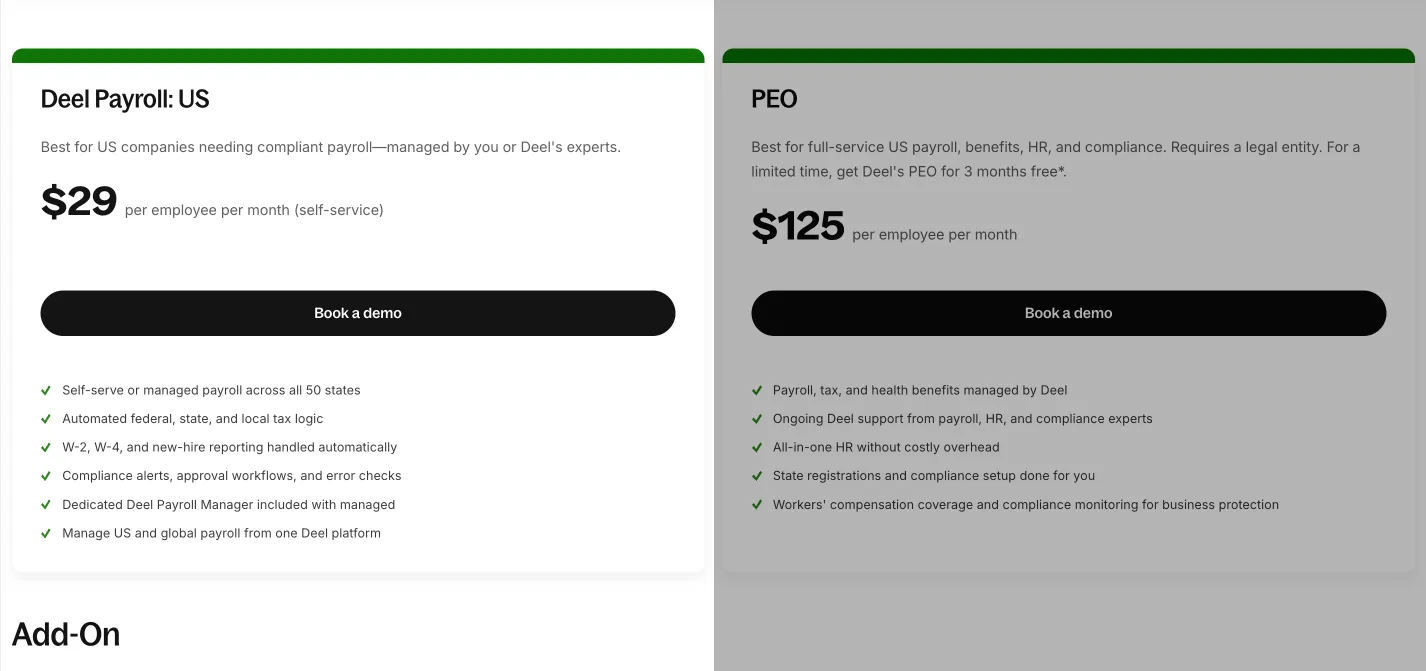
Deel’s US Payroll product handles compliant payroll across all 50 states. If you already have a legal entity and simply need payroll managed cleanly, this is the most straightforward option.
Deel’s US Payroll product:
- Covers all federal, state, and local tax filings, and remittance
- Processes W-2, W-4, and 1099 forms along with new hire reporting
- Monitors payroll compliance and regulatory updates
- Connects with your existing HR and accounting software
- Provides employee self-service portals
Deel Hidden Costs
Deel advertises that it has no hidden fees, and most employer reviews on G2 support this claim.
However, there are two areas worth flagging before you sign up.
- From the employee side, fees aren't always as clean as advertised. The most common frustration across G2 reviews is what you might call the "middleman" problem. When withdrawing to a local bank, small amounts can disappear due to intermediary bank charges or exchange rate markups that Deel doesn't always control or clearly disclose upfront.
- From the employer side, the bigger issue is pricing complexity. The number you see on the pricing page is a floor, not a ceiling.
Deel's PEO, for instance, covers payroll, compliance, and benefits access at $125/employee/month. But anything beyond that is a separate purchase. These costs aren’t hidden in the traditional sense, but they’re also not as straightforward as they first appear.
Deel Pros & Cons
Deel is a well-built platform that solves real problems for companies hiring across borders. But every strength comes with a tradeoff, and some of those tradeoffs matter more depending on your team size, location, and what you're actually trying to fix.
Pros
- Global reach: EOR and payroll services available across multiple countries, backed by in-house legal infrastructure in most regions instead of third-party providers.
- Hiring and onboarding speed: Deel reports EOR hires take just 2-5 days, while US PEO onboarding takes around 5 minutes per employee.
- Modular platform: Pay only for the services you use. Contractors, EOR, payroll, and HR are all purchasable independently.
- Benefits enrollment: Access to national health plans from Aetna and Kaiser, 401(k), dental/vision, and supplemental benefits directly through the platform.
- Integrated platform: Payroll, HR, IT, and benefits are managed in one system, reducing tool sprawl for globally distributed teams.
Cons
- PEO pool pricing: Benefits costs in Deel’s PEO are set at the pool level rather than the individual company level. That structure can work against companies with younger, healthier teams, which may pay higher rates than their own risk profile would justify.
- No genuine benefits market audit: Deel's PEO gives you access to health plans within its network. What it doesn't do is go outside that network to compare every available carrier, plan, and funding structure against your workforce's risk profile. Most founders never find out if they're overpaying on health insurance.
- EOR cost at scale: At $599 per employee per month, Deel’s EOR costs $7,188 per employee annually. A team of 10 EOR employees would cost $71,880 a year in platform fees alone, before salaries and benefits. As headcount grows, setting up a local entity may become the more economical option.
- Module costs stack up: Adding HR, IT, and benefits administration to a PEO or EOR plan introduces additional per-employee fees that are difficult to calculate upfront without a custom quote.
- Platform performance: Deel's app and website are consistently flagged for slow load times and laggy navigation between menus.
Find out if you’re overpaying for health insurance →
Who Is Deel Best For?
- Globally Distributed Startups (Seed to Series B)
If you're hiring engineers, designers, or sales teams across multiple countries and don't have legal entities set, Deel EOR is a legitimate solution. The 2-5 day hire timeline and in-house compliance infrastructure in 130+ countries is hard to replicate at early stages. The $599/month per employee cost is high but often cheaper than the alternative: entity setup and local legal fees in each country.
- US Companies Scaling From 10-50 Employees
Deel’s US PEO, at $125/employee/month, bundles payroll, compliance, and benefits access into a single package. For founders without an in-house HR hire, that simplicity is a real advantage early on.
The trade-off shows up as you scale. As headcount approaches 50 employees, pooled pricing can start to work against you. That’s typically the point where it makes sense to run a full-market benefits audit, something Deel and most PEOs don’t do.
- Contractor-Heavy Operations
For companies managing blended W-2 and 1099 workforces across multiple countries, Deel’s Standard ($49/contractor/month) and Contractor of Record ($325/contractor/month) products handle classification risk, compliant contracts, and multi-currency payments in one platform. When misclassification is a real risk in your workforce structure, Deel offers a reliable way to manage it.
Deel Customer Reviews
Deel has a 4.8/5 rating on G2 and more than 14,000 reviews across its product suite. Here's what users like most about the platform and the issues they mention most often.
Positives
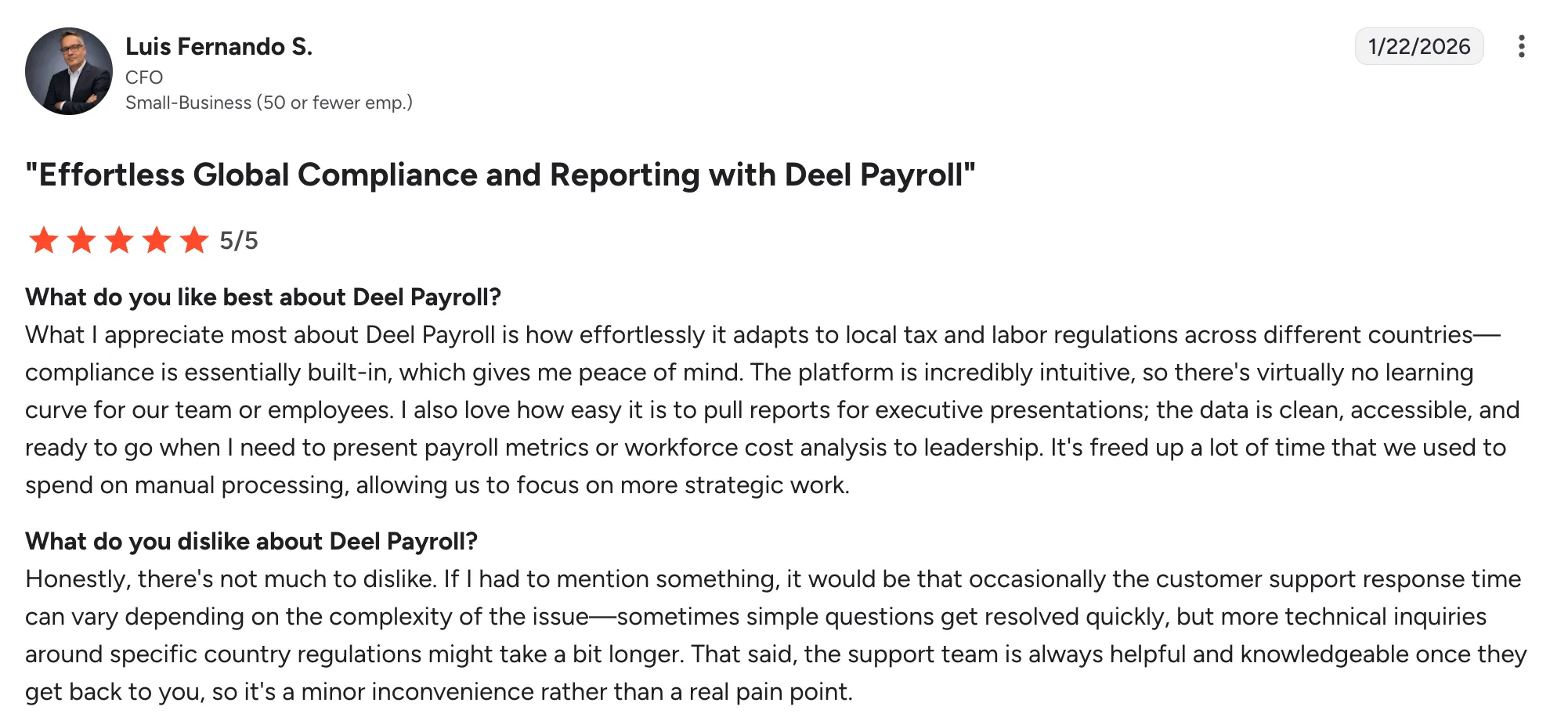
Luis Fernando S. says Deel takes the stress out of cross-country compliance and makes pulling payroll reports for leadership meetings quick and straightforward.
A verified user in online media highlights Deel’s UX, customer success support, and the range of employment models and country-specific benefits available on the platform.
.webp)
Complaints
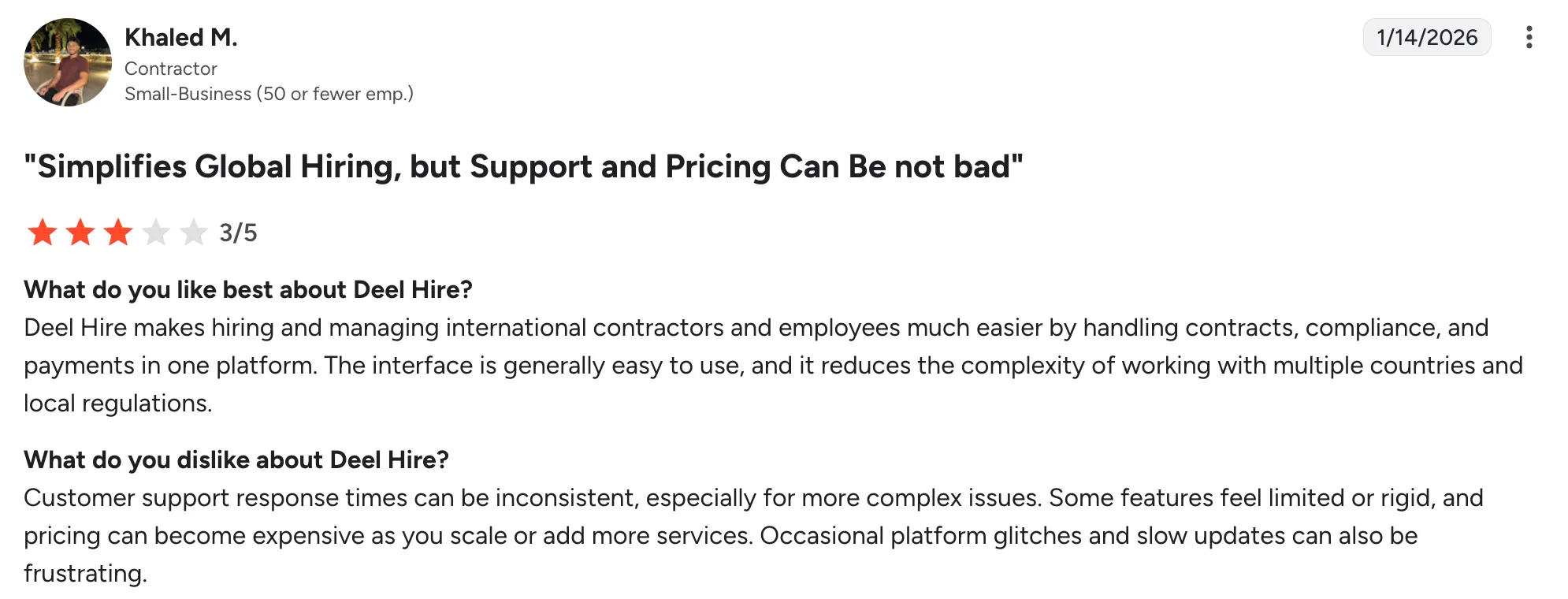
Khaled M. shares that support response times can be inconsistent for complex issues, and that pricing escalates quickly as you scale or add more services.
A verified user in accounting points out that costs can add up fast once you start combining EOR, PEO, and contractor management and that per-worker charges can feel steep for smaller teams.
.webp)
Alternative To Deel: Ignition Benefits
Deel solves a global hiring and payroll problem. But if your team is US-based and you’re dealing with rising health insurance premiums and limited visibility into what’s driving them, Ignition Benefits is built for that.
Ignition is a transparent benefits brokerage built for founders and operators at companies with up to 200 employees. It doesn't compete with Deel on payroll or international hiring. It specializes in what Deel's PEO doesn't do: running a genuine full-market audit of your employee benefits and answering whether you're overpaying on health insurance.
Ignition clients save 20% on benefits in the first year. Here’s how that happens:
- Benefits Risk Score: Ignition pulls in the same risk score every carrier already has on your workforce before going to market. If your team is young and healthy and you're on a fully insured plan, that score is proof your renewal increase isn't justified.
- Full market audit: Every available carrier, plan, and funding structure is compared against your workforce data. For most healthy startup teams, a level-funded plan returns unused premiums at year-end. Most founders on PEOs have never been offered this option.
Does Deel Pricing Fit Your Budget?
Deel is a strong solution for what it's designed to do: global hiring, international payroll, and US co-employment. If you're managing contractors across 15 countries or hiring full-time employees without local entities, the platform justifies the cost.
But if you're a US-based founder at a company with up to 200 employees and your main question is whether your health benefits are priced correctly, Deel's PEO doesn't answer that. It gives you access to plans, but it doesn't tell you whether those plans are the right fit for your workforce's risk profile, or whether you're subsidizing higher-risk companies in a pool.
Ignition Benefits answers that at no cost to you.
FAQs
Is Deel free?
No, Deel does not offer a free plan. All products are priced on a per-unit basis, such as per employee, contractor, or device.
How much does Deel charge for EOR?
Deel EOR starts at $599 per employee per month for the Standard plan and $899 per employee per month for Enterprise, which adds dedicated onboarding, legal response guarantees, and advanced security features.
Does Deel charge a setup fee?
Deel does not advertise a setup fee on its pricing page.
What are Deel's hidden costs?
Deel advertises no hidden fees, and most customer reviews back this up. That said, employees can lose small amounts to intermediary bank charges or FX markups. For employers, costs can climb quickly once add-ons stack on top of the base plan.



_%20Which%20One%20Wins%20for%20Your%20Team_.webp)

![How to Reduce Small Business Health Insurance Costs [2026]](https://cdn.prod.website-files.com/69f22330e53a32bb7629af15/6aa04b2f5dbdf3dc6b28b351_How%20to%20Reduce%20Small%20Business%20Health%20Insurance%20Costs%20%5B2026%5D%20(1).webp)
.webp)




.webp)



.webp)

.webp)








.webp)





.webp)








.webp)




.png)

