.svg)

.svg)


.webp)

- Ignition Benefits is the best benefits broker for founders and operators at 10-500 person companies who want full transparency on what they're paying and a full market audit delivered in 14-21 days.
- Marsh McLennan Agency is recommended for middle-market employers who need medical, pharmacy, compliance, and PEO consulting managed under one roof.
- Nava Benefits suits companies with mature HR teams who want technology that cuts admin work and supports employees year-round.
- Aon is the best benefits broker for large global enterprises, backed by $650 billion in claims data and operations across 120+ countries.
- Arthur J. Gallagher is recommended for companies looking for a benefits broker with experience in specialized industries like healthcare, construction, and financial services.
You're reading this article for one of two reasons.
Either you just got hit by a renewal hike with no real explanation, and you're wondering if your broker is actually working for you. Or you're setting up a benefits package for the first time and you don't want to make a decision you'll regret when headcount increases.
Both are the right moment to shop the market for a benefits broker.
This article explores five of the best employee benefits brokers in 2026 and covers what each one does well, who they’re best suited for, and where they fall short.
Top Benefits Brokers in 2026: A Quick Overview
1. Ignition Benefits: Best for Founders Who Want Full Transparency on Benefits Spend
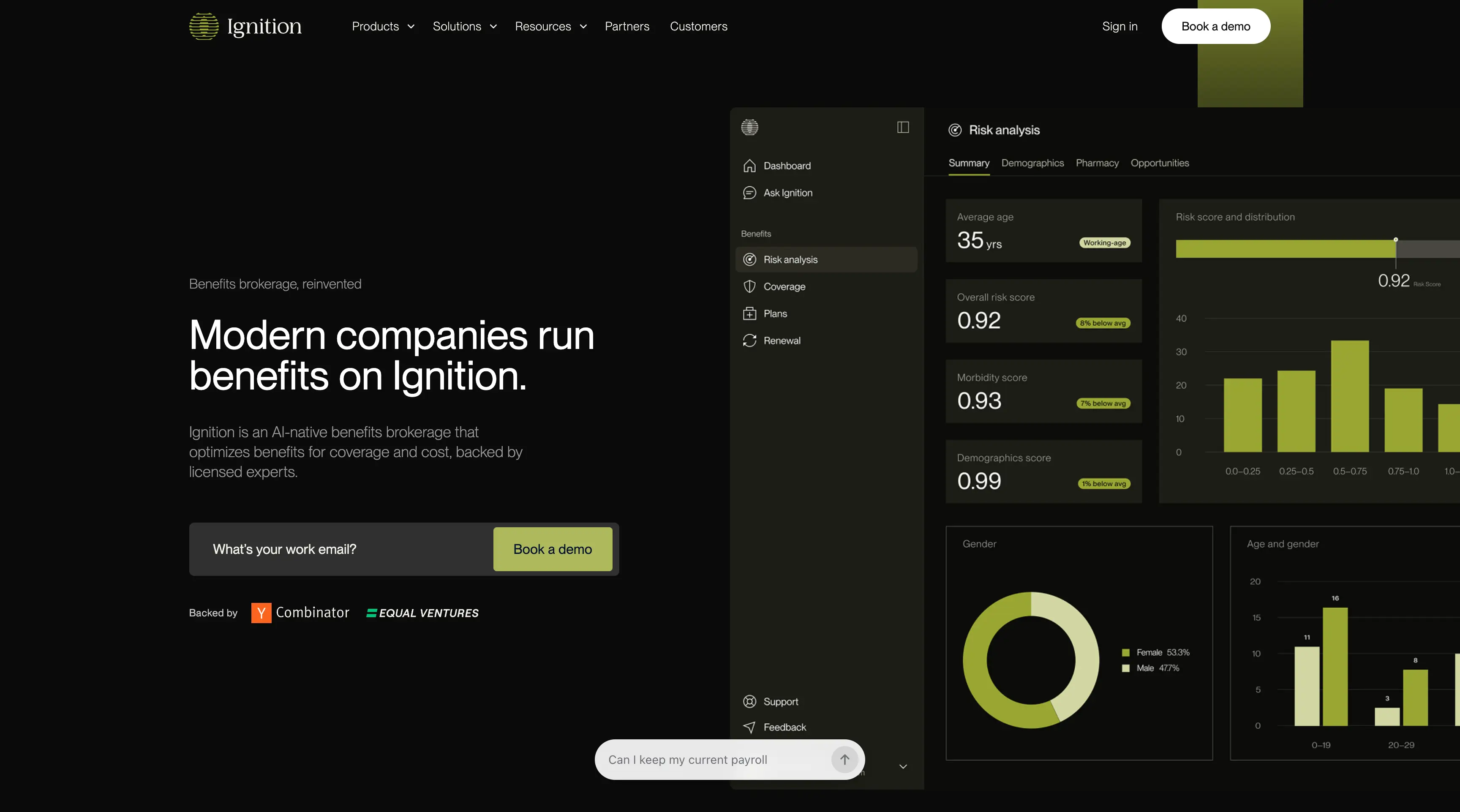
Ignition Benefits is an employee benefits brokerage built for founders and operators who still manage benefits decisions themselves. Clients typically reduce benefits costs by 20% in the first year because Ignition brings transparency to a process that is often opaque.
Instead of simply renewing existing plans that most brokers do, Ignition conducts a full market audit at each renewal and recommends the health plan that makes the most financial sense.
It was founded by Nick Taranto, who co-founded and scaled Plated to 1,500 employees before its acquisition by Albertsons. While building Plated, he watched brokers earn commissions on his company's premiums without ever running a full market review. Ignition was built to fix exactly that.
Ignition Benefits Key Features
Benefits Risk Score Visibility
Every insurance carrier scores your workforce before pricing your renewal. They look into factors like age, gender, and location to generate a risk score that directly influences your premium. Most brokers have access to this data, but they rarely share it with the client.
Ignition shares that score before going to market. This gives founders visibility into how carriers are likely to price them, so they can challenge assumptions when premiums don’t reflect their employees’ risk profile.
Pro Tip: Regional rating factors heavily influence carrier pricing in state-specific markets. Working with a specialized California employee benefits broker allows employers to evaluate workforce risk scores against local market benchmarks before renewal quotes arrive. In markets dominated by single carriers, consulting an Illinois employee benefits broker or a dedicated New York employee benefits provider can help uncover alternative full-market quotes that traditional renewals miss.
Full Market Audit
Most brokers come back at renewal with a few options and call it a market check. In practice, those options often come from the same small set of carriers they work with year after year.
Ignition runs a full market review instead, across carriers, plan types, and funding structures. The findings are compiled into a Benefits Analysis Report in plain language: what you’re paying today, what alternatives exist, and what makes the most sense for your team. Employers looking to streamline plan selection can also evaluate benefits decision support tools to help optimize coverage choices.
To learn more about how advisory teams help optimize coverage, explore our guide on the benefits of consulting firms.
No Carrier Runaround
Once the decision is made, Ignition handles every carrier call, form, and follow-up. Founders only need to invest 30 minutes of their time: a 15-minute call to share workforce details, and another 15-minute call to review the proposal. After that, Ignition manages the rest.
Find out if you’re overpaying for benefits. See what your team should actually cost.
Ignition Benefits Pricing
Ignition is compensated through carrier commissions, the same model used across the broker industry. There is no direct cost to the employer for the brokerage service itself. What's different is that Ignition discloses every dollar of its compensation upfront.
You can also estimate broker payout structures using a broker commission calculator to see how these fees impact overall health plan costs.
Where Ignition Benefits Shines
- Fast turnaround: Traditional brokers take 8-12 weeks to run a market review. Ignition delivers the same depth of analysis in just 14-21 days.
- Complete transparency: Benefits are usually the second-largest line item on the P&L, and the one founders can defend the least. Ignition shows what the market rate looks like for your team and why you’re paying what you are, giving founders the data to defend decisions with confidence in board meetings.
- Minimal setup effort: Switching to Ignition doesn't mean leaving your PEO or disrupting your employees' plans. All it takes is a Broker of Record letter, a single document that formally appoints Ignition as your broker with the carriers.
Where Ignition Benefits Falls Short
- Not built for large enterprises: Ignition is designed for companies in the 10-500 employee range. Larger organizations with formal procurement, internal benefits teams, and 500+ employees are typically better served by enterprise-focused group benefits brokers.
Who Ignition Benefits Is Best For
- Founders and operators at 10-500 person companies who want to offer competitive employee benefits at a lower cost.
- Companies on a PEO or working with an existing broker who suspect they’re being overcharged and want to take control of benefits decisions themselves.
Growing mid-market businesses looking for a localized Texas employee benefits broker to help optimize group health plan spend.
2. Marsh McLennan Agency: Best for Middle-Market Employers

Marsh McLennan Agency is the insurance and risk advisory arm of Marsh McLennan, one of the largest professional services firms in the world. Benefits is one of four core service lines alongside business insurance, private client services, and retirement and wealth.
Its employee health and benefits practice spans medical, pharmacy, compliance, absence and disability management, PEO consulting, and voluntary benefits, among other areas.
Key Features
- Health plan design: MMA helps employers build benefits plans aligned with their business goals. Alongside insurance placement and pricing negotiations, they focus on managing benefits spend by identifying cost drivers.
- Planning and Analytics for Total Health (PATH): A real-time data tool that monitors benefits plan performance after it's been placed. It tracks whether carriers are delivering on their commitments and flags overspending.
- Employee engagement and HR support: MMA provides tools and guidance to help employees understand and use their benefits well. They also support HR teams with training, coaching, and advice on workforce risk and retention.
- PEO consulting: MMA has a dedicated PEO exit strategy practice for employers considering leaving their PEO for a better health coverage plan.
To better understand why companies make this transition, review our PEO vs Broker comparison.
Pricing
Contact MMA’s team to learn more about their pricing.
Where MMA Shines
- Breadth of services: Medical, pharmacy, compliance, voluntary benefits, and PEO consulting all under one roof. For employers with complex needs, this reduces the need to manage multiple advisors.
- Strong analytics: PATH gives employers ongoing visibility into whether their plan is actually performing, not just at renewal but throughout the year.
Where MMA Falls Short
- Less suited for early-stage startups: MMA is built for more established employers with HR infrastructure. Founders at the 10-50 employee stage will find the depth of services excessive for their needs.
Who MMA Is Best For
- Middle-market employers seeking a broad employee benefits insurance broker with deep compliance and HR technology support.
3. Nava Benefits: Best for Companies with Mature HR Teams
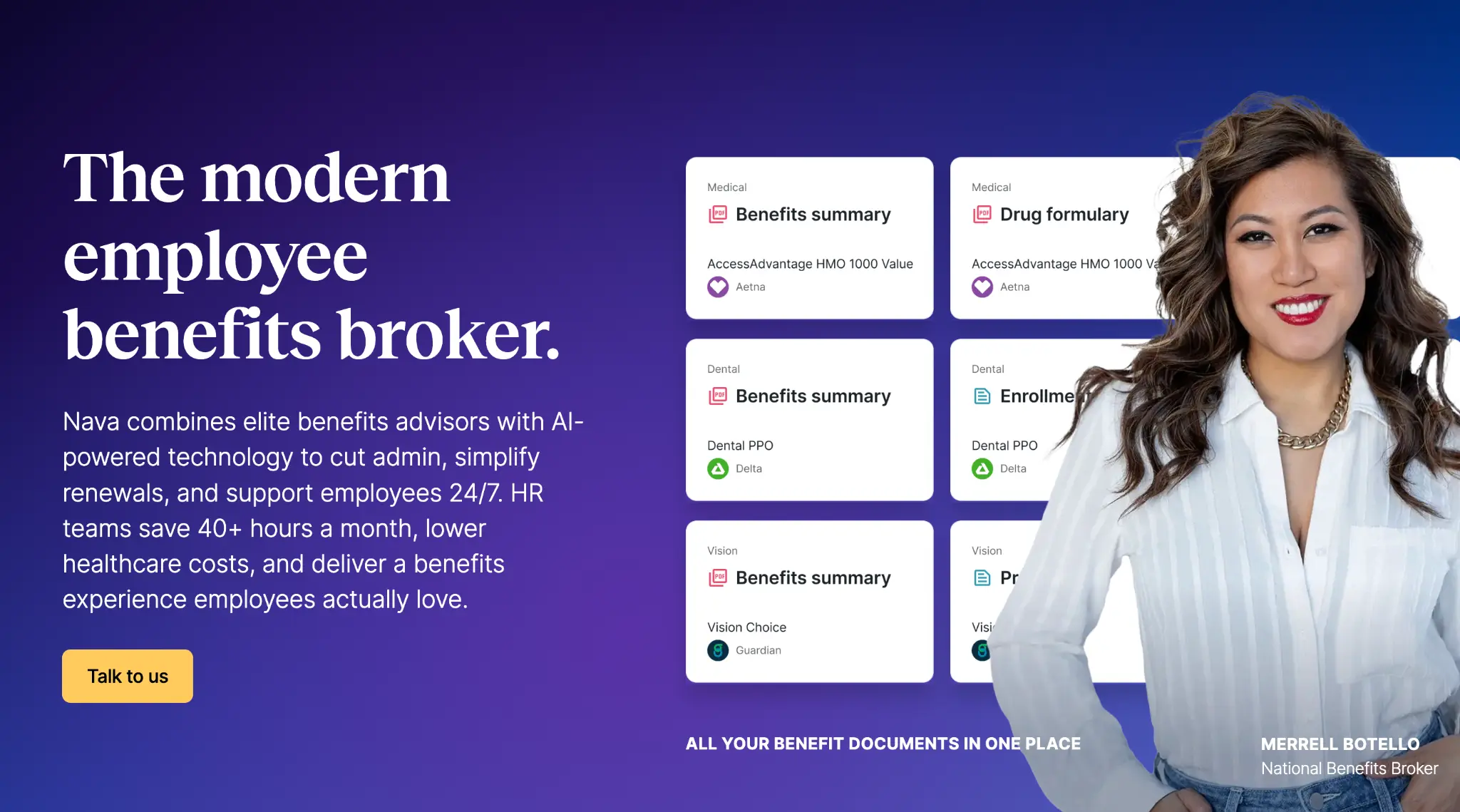
Nava Benefits is a modern employee benefits brokerage that combines experienced benefits consultants with their AI-powered platform called HQ.
Nava is a strong fit for mid-sized employers with established HR teams who want technology that reduces admin work and supports employees year-round.
Key Features
- Alternative funding expertise: Nava's brokers have experience in self-funding, PBMs, and captive structures, which goes beyond what most traditional employee benefits consultants offer.
- HQ for HR teams: An AI-powered benefits platform that centralizes renewals, documents, billing audits, and benefits admin integrations in one place.
- HQ for employees: A 24/7 mobile app that gives employees instant answers about their benefits, provider search, digital ID cards, and medical spending.
For a closer look at the platform's capabilities and user feedback, read our Nava Benefits review.
Pricing
Contact Nava’s team to learn more about their pricing.
Where Nava Benefits Shines
- HR admin reduction: Nava reports that its HQ platform saves HR teams 40+ hours a month by centralizing renewals, documents, and billing audits in one place.
- Employee experience: The employee-facing app and 24/7 support make it easier for employees to understand and use their benefits without relying on HR for every question.
Where Nava Benefits Falls Short
- Skews toward mid-market with HR infrastructure: Nava is a strong candidate for companies with a dedicated HR team. Founder-led companies without HR staff will find Ignition Benefits a better fit for their stage.
- Less focus on PEO lift-out: Nava's positioning is more focused on replacing traditional brokers than specifically on the PEO-exit use case that others on this list specialize in.
Who Nava Benefits Is Best For
- Mid-sized companies looking for a tech-forward benefits brokerage with strong employee-facing tools.
4. Aon: Best for Global Enterprises

Aon is a global professional services firm with a dedicated employee benefits broking and consulting practice. They project U.S. employer healthcare costs will rise 9.5% in 2026. Their benefits practice is built around helping large employers manage that cost pressure without reducing coverage quality.
Key Features
- Employee benefits brokerage: Aon uses $650 billion in claims data to advise employers on carrier discounts, network coverage, and provider access. Their scale gives clients access to competitive carrier terms and pricing that smaller brokers cannot negotiate independently.
- Benefits insights and analytics: Aon’s proprietary analytics combine employee health data, insurance claims, workplace safety, engagement metrics, and program data to help employers optimize benefits spend.
- Global benefits: For multinational employers, Aon helps manage benefits across countries, navigating different regulations, carriers, and plan structures.
- Pensions and retirement: Alongside health benefits, Aon advises employers on retirement plan design and management. This helps companies build benefits packages that support both employee health today and financial security in the future.
Pricing
Contact Aon directly to know about their pricing.
Where Aon Shines
- Global reach: With presence in 120+ countries, Aon is one of the few largest employee benefit brokers that can manage benefits for multinational workforces.
- Strong analytical approach: Aon's data capabilities go well beyond what most group benefits brokers offer to provide competitive plans to its clients.
Where Aon Falls Short
- Not built for startups or SMBs: Aon's model is built around the needs of large, complex organizations. Companies under 100 employees are unlikely to get the full benefit of their scale and data capabilities.
- Overkill for US companies: A major part of Aon's value proposition is managing benefits across borders. US-based companies with no international workforce are paying for capabilities they will never use.
Who Aon Is Best For
- Large enterprises with 1,000+ employees that need to secure and manage benefits plans across countries.
5. Arthur J. Gallagher: Best for Companies in Specialized Industries

Arthur J. Gallagher is one of the largest employee benefit brokers in the world, with over 95 years in business, $13.8 billion in revenue, and more than 1,116 offices across 130+ countries, as stated on its website.
They work with employers of all sizes, from local businesses to multinational organizations, covering health benefits, compliance, plan administration, and global benefit management.
Key Features
- Benefits program design: Rather than a standard package, Gallagher builds each benefits program around the employer's risk tolerance, financial goals, and workforce needs.
- Benefit administration: Gallagher handles employee enrollment and plan administration, with a dedicated Benefit Advocate Center staffed to help employees with claim and plan questions throughout the year.
- Global health: For employers operating across borders, Gallagher manages benefits across multiple countries, covering global benefit management, multinational pooling, risk financing, and expatriate mobility.
Pricing
Custom pricing, contact Gallagher’s team directly.
Where Gallagher Shines
- Industry specialization: Gallagher’s team includes brokers with experience across 20+ industries, including construction, technology, nonprofits, and financial services. Employers get a broker who already understands the risks and exposures specific to their business, saving them time overall.
- Global scale: 130+ countries and deep local advisor networks make Gallagher one of the few employee benefits brokerages built for truly multinational employers.
Where Gallagher Falls Short
- More value at larger scale: While Gallagher works with employers of all sizes, their full suite of services delivers the most value to larger, more complex companies. Smaller employers may not need that depth.
Who Gallagher Is Best For
- Companies in specialized industries like healthcare, construction, or financial institutions who want a broker with specific experience in their sector.
How to Choose the Best Benefits Broker for Your Company
Not every company needs the same type of benefits broker. The right fit depends on your headcount, your current benefits setup, and the specific challenge you’re trying to solve.
Fee Transparency
Most founders have no idea how their benefits broker gets paid. The Consolidated Appropriations Act of 2021 gives every employer the legal right to request full broker compensation disclosure. But, most employers have never been told this.
When evaluating a benefits broker, ask directly:
- How are you compensated?
- Does your commission increase when my premiums increase?
If a broker can’t answer clearly, it’s worth questioning the advice you’re getting.
Ignition Benefits discloses every dollar of its compensation before the engagement begins, including the commission structure and carrier relationships behind it.
Pro Tip: Regional rating factors and state regulations heavily influence health plan costs. Partnering with a dedicated Massachusetts employee benefits broker helps regional employers audit localized carrier options alongside similar regional markets such as California to secure competitive renewal terms.
Broker Turnaround Time
The traditional broker process takes 8-12 weeks to complete a market audit. For a founder who just received a 15% renewal increase and has only 30 days to respond, that pace is too slow.
Ask any broker you're evaluating:
- How long does your market audit take?
- What do you need from me and when?
- How many calls will this require?
Ignition completes a full market audit and delivers a Benefits Analysis Report in 14-21 days. The process requires only two 15-minute calls from the employer.
Full-Market Access
Many brokers have preferred carrier relationships, which means the options they present are not the full market. They present two or three plans, call it a market check, and move on. The employer has no way to know what they’re missing out on.
A genuine full-market audit includes every available carrier, plan type, and funding structure (fully insured, level-funded, and self-insured). For companies with younger, healthier workforces, level-funded plans can return unused premiums at the end of the year. That can create meaningful savings many brokers never bring up.
Ask any benefits broker whether they have preferred carrier relationships and how those relationships affect the options they present. Then, ask to see the full market.
Ignition Benefits has no preferred carriers. Every renewal includes a review of all carriers, plans, and funding options.
See how a stronger employee benefits strategy can help control benefits costs.
Company Size
The best benefits broker for a 500-person enterprise is not the right fit for a 25-person startup. The needs, constraints, and priorities are fundamentally different, as are the ways value is created and where broker time is spent.
A startup founder needs a broker who can operate without a full HR team, move quickly on analysis, and think in terms of runway and headcount rather than employee communications and rollout management.
An enterprise HR leader needs a broker with deep compliance expertise, global coverage, and the ability to manage benefits across multiple employee groups and regulatory requirements.
Stop Renewing Blind. See What Your Benefits Should Actually Cost.
Most companies renew their benefits plan on autopilot. Their broker sends a renewal. The employer accepts it. The premium goes up. Nobody asks whether the price reflects the actual risk of the workforce.
If you've never seen your Benefits Risk Score, never had a full-market audit run, and never asked your broker what they earn from your premiums, you are almost certainly leaving real money on the table.
Ignition brings transparency into the process, helping founders benchmark their benefits spend and secure the same or better coverage at a lower bill.
Stop Renewing Blind. See What Your Benefits Should Actually Cost.
Most companies renew their benefits plan on autopilot. Their broker sends a renewal. The employer accepts it. The premium goes up. Nobody asks whether the price reflects the actual risk of the workforce.
If you've never seen your Benefits Risk Score, never had a full-market audit run, and never asked your broker what they earn from your premiums, you are almost certainly leaving real money on the table.
Ignition brings transparency into the process, helping founders benchmark their benefits spend and secure the same or better coverage at a lower bill.

.jpg)
.webp)

.webp)

.png)










_%20Which%20One%20Wins%20for%20Your%20Team_.webp)

![How to Reduce Small Business Health Insurance Costs [2026]](https://cdn.prod.website-files.com/69f22330e53a32bb7629af15/6aa04b2f5dbdf3dc6b28b351_How%20to%20Reduce%20Small%20Business%20Health%20Insurance%20Costs%20%5B2026%5D%20(1).webp)
.webp)




.webp)



.webp)

.webp)









.webp)





.webp)







.webp)




.png)

