.svg)

.svg)

.webp)
.webp)

- Level-funded plans fit a small business with a young, healthy team that wants a fixed monthly bill and money back if claims stay low.
- ICHRA suits a company with a remote or multi-state workforce that wants to reimburse employees tax-free for their plans, with no size restrictions or IRS cap on contributions.
- QSEHRA works for a business under 50 employees with no group plan that wants a simple, capped, tax-free allowance.
- Self-funded plans suit a larger, stable group that can pay claims directly, keeping the savings in a low-claims year but taking the hit in a bad one.
- An independent broker like Ignition Benefits is what lowers your cost. They get quotes from every carrier at renewal and show you what they're paid. The plan matters less than having someone check the whole market before you sign.
Your health insurance renewal came back with a double-digit increase from last year, and you asked your broker why. The answer was that costs went up across the board. Before you sign it, know that traditional fully-insured group coverage is one option among several.
The main alternatives for small businesses are level-funded plans, ICHRAs, QSEHRAs, and self-funded plans. The right fit depends on your headcount, your team's health, and how much financial risk you can take on.
With employer-sponsored premiums in 2025 reaching $9,325 and $26,993 for single and family coverage, respectively, the numbers are too large to ignore. So, this guide breaks down each alternative, who it's built for, how the pricing works, and the one decision that actually lowers your costs.
Health Insurance Alternatives for Small Business: A Quick Look
1. Independent & Transparent Broker
An independent broker gets quotes from every carrier on your behalf instead of selling plans from a payroll platform or the insurers it has a deal with.
A benefits broker isn’t your typical "alternative," but for a company of up to 200 employees with a healthy workforce, who picks the plan changes the result more than which plan you pick. The broker decides whether you ever see the other options on this list.
The challenge with this approach is that most brokers earn a commission from the carrier, and that commission usually rises with the size of your premium. When your premium goes up, the broker's pay goes up, so they earn more when you spend more.
What to Look for in an Independent Broker
Three things separate a broker who works for you from one who works for the carrier. Get them right and you'll know within one conversation whether your broker is worth keeping.
1. Compensation Transparency
You have a legal right to see how your broker gets paid. Under Section 202 of the Consolidated Appropriations Act, 2021, brokers must disclose in writing all direct and indirect compensation over $1,000 they expect to receive for services to a group health plan. Most founders have never heard of this.
Ask the broker how much they get paid and by which carriers. A broker who works for you will give you the full number, including base commission, bonuses, and carrier incentives. A broker who won't do so is indirectly telling you to consider someone else.
2. A True Full-Market Audit
Most brokers show two or three options from a couple of carriers and call it a market check. A real audit gets quotes from every carrier and tests each plan against your actual workforce data. It also includes a funding review covering fully insured, level-funded, and self-insured structures.
3. How Fast You Get the Analysis
Ask how long the broker takes to go from your census to a finished recommendation. Most take 8 to 12 weeks for a full market review, and if that runs past your renewal date, you re-sign the current plan by default. A broker who performs the analysis faster leaves you time to compare options and negotiate before the deadline.
Our Pick: Ignition Benefits
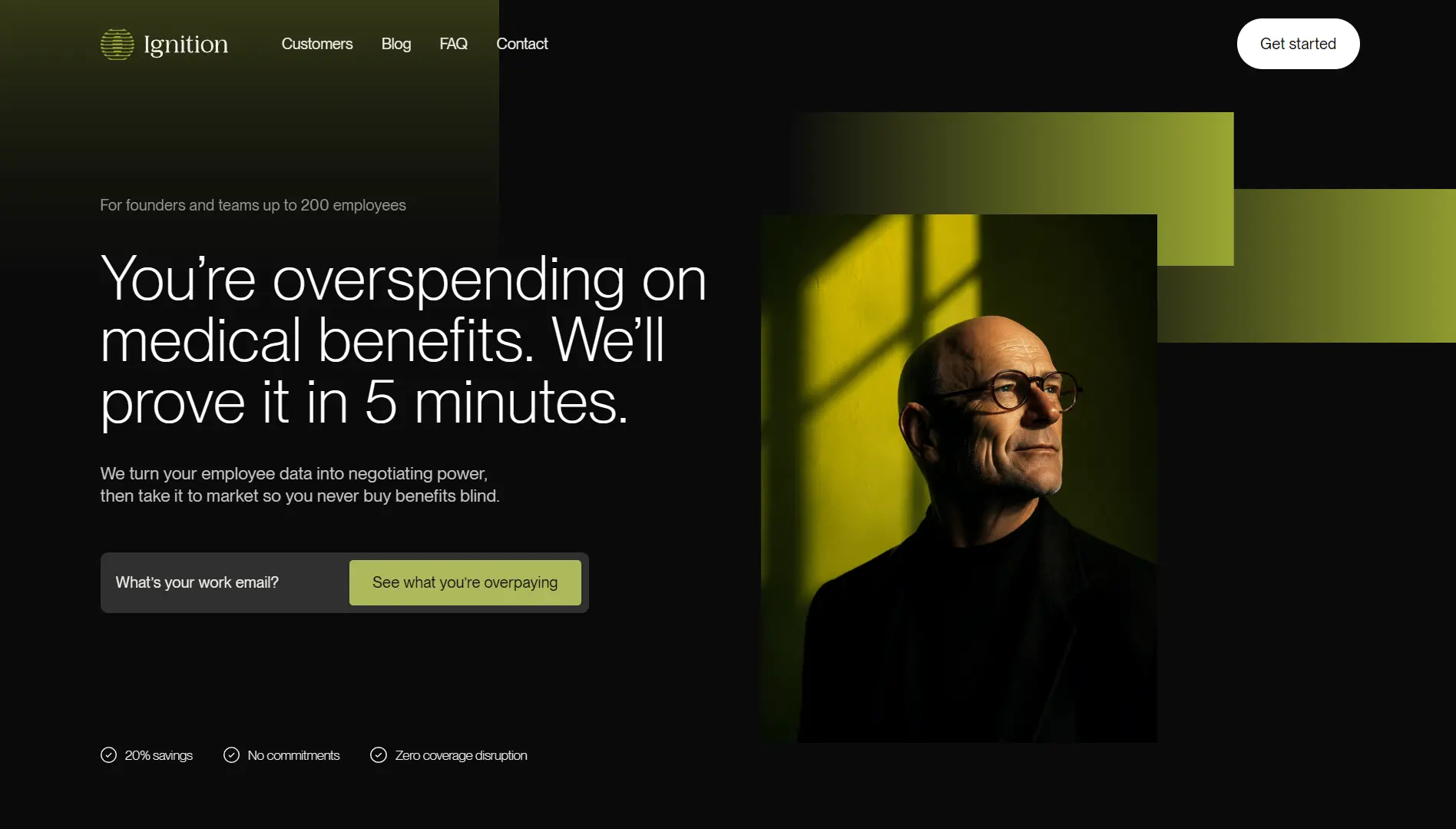
Ignition Benefits is a transparent, AI-native insurance brokerage built for founders who still own the benefits decision themselves. The goal is to get you off an unfavorable health insurance plan that renews automatically and onto one chosen from current market quotes, with every dollar of the broker's pay disclosed on day one.
Feature #1: The Benefits Risk Score
Every carrier scores your workforce's health risk to set your renewal price, and most don’t voluntarily disclose it. Ignition pulls it before getting quotes and shares it with the employer.
The score reflects the age, gender, and location of your team, so a young, healthy startup usually scores low. When your premium is high and your score is low, you're paying more than your team's risk justifies, and Ignition uses that gap to negotiate.
Feature #2: The Full Market Audit
At every renewal, Ignition gets quotes from every carrier and tests each plan against your actual workforce data, not just a handful of quotes from its usual carriers. The audit includes a funding review across fully insured, level-funded, and self-insured structures. For most startups with young, healthy teams, that review might turn up a level-funded option the previous broker never quoted.
Feature #3: The Benefits Analysis Report
Ignition gives you this document at the end of the analysis. It shows how your current plan compares to every considered option on the market, lays out your workforce's risk profile, and gives a clear recommendation. Most brokers take 8 to 12 weeks to produce a review like this. Ignition delivers it in 14 to 21 days.
Ignition Benefits Pricing
Where Ignition Benefits Shines
- You see what Ignition earns: Every dollar of Ignition Benefit’s pay is disclosed before you sign, so you can judge the advice against what they make from it.
- Every carrier gets checked: Each carrier, plan, and funding structure is quoted against your team's data at every renewal, with no carrier deals limiting the options.
- No carrier runaround: Ignition handles the back-and-forth with carriers for you, from the first quote request to the final numbers, so you're not chasing insurers to get answers.
- Same depth, less time: A company with 200 employees or less gets the analysis a legacy broker reserves for a 500-person client, delivered in 14 to 21 days instead of 8 to 12 weeks.
Where Ignition Benefits Falls Short
- Built for a specific size: Ignition is designed for companies with up to 200 employees. A sole proprietor with no W-2 employees or a 2,000-person company with its own benefits team isn’t a good fit.
- US only: The model is built around the US employer market, so a company with most of its team outside the US won't get the same value.
Who Ignition Benefits Is Best For
- The founder or CFO who makes the benefits decision: Best for teams of up to 200 employees at VC-backed company with a younger, healthy team, looking at this after a renewal increase, as headcount nears 50, or when the board starts asking about burn.
You can check the carrier's risk score on your team and get quotes from every carrier before you sign the renewal. See what your benefits should cost with Ignition Benefits.
2. Level-Funded Plans: Best for Healthy Small Teams
A level-funded plan falls in between fully insured and fully self-funded. You pay a fixed monthly amount, like a traditional plan, and that money splits into three portions: a claims fund, stop-loss insurance, and administrative costs.
These plans count as a type of self-funded plan, which often exempts the business from some state premium taxes and certain ACA regulations. Another reason to use a level-funded plan is the refund. If your team's medical claims for the year are below expectations, you get the surplus money back.
Level-Funded Plan Key Features
Fixed Monthly Cost With a Possible Refund
Employers with a level-funded plan pay a fixed monthly fee covering the maximum claims liability, administrative fees, and stop-loss insurance. Unlike fully insured plans, unused claims money comes back to you at the end of the year instead of staying with the carrier.
Built-In Stop-Loss Protection
Two layers of stop-loss cap your risk. Specific stop-loss caps the cost of any single employee's claims above a set threshold, and aggregate stop-loss caps total group claims, usually set at 125% of expected claims for the year. Your maximum cost is fixed before the year starts, so a high-claims year won't bill you beyond that cap.
Claims Data You Can See
Fully-insured plans usually give employers limited reporting, while level funding gives you monthly data on how your team uses care, including emergency visits and prescriptions. You see total spending by category, never individual employee health information, and HIPAA rules apply the same way they do on any plan.
Pricing
Where Level-Funded Plans Shine
- Money back for a healthy team: When your team uses less care than the carrier projected, the unspent claims money comes back to you instead of staying with the carrier.
- A fixed maximum cost: Stop-loss means one expensive claim or a high-claims year won't cost you more than the cap set at the start.
- You can see what drives the cost: Monthly reports show which categories of care your spending goes to, so you can change the plan design in response.
Where Level-Funded Plans Fall Short
- You need enough people: These plans work well for 10-to-100-employee groups; below 10, there may not be enough people to spread the risk.
- More work than fully insured: You'll review quarterly claims reports and work with a third-party administrator, which is more involved than a plan the carrier runs for you.
- A high-claims team can wipe out the refund: A team that files a lot of claims may get no refund, though stop-loss still caps your cost.
Who Level-Funded Plans Are Best For
- The small employer with a young, healthy, stable team: Best for a 10-to-100-person company that wants the same bill every month and will do some admin work for the chance at a year-end refund.
3. ICHRA: Best for Distributed Workforces
An Individual Coverage Health Reimbursement Arrangement (ICHRA) works the other way around from level-funded. Instead of buying a group plan, you reimburse employees tax-free for individual health insurance they buy themselves. The reimbursements aren't taxable income, employers pay no payroll taxes on them, and they count as a business expense for the employer.
Key Features
No Size Limit and No Contribution Cap
An organization can offer an ICHRA whether it's a 5-person startup or a 500-person company, and there's no IRS cap on how much you reimburse. You set the monthly amount to fit your budget. That freedom to set any amount is the main reason ICHRAs have spread across company sizes.
Employee Classes
You can sort employees into classes such as full-time, part-time, seasonal, salaried, and location-specific and set a different reimbursement amount for each. You can offer a group plan to one class and an ICHRA to another, though you shouldn’t let the same class choose between the two.
Satisfies the ACA Employer Mandate
For a company with 50 or more full-time-equivalent employees, an ICHRA can meet the Affordable Care Act's employer mandate as long as the amount you offer is affordable. Offering an ICHRA counts as offering coverage under that mandate.
Pro tip: Employees have to enroll in individual market coverage or Medicare to use ICHRA, and most get a notice from the employer at least 90 days before the plan year starts. Plan your rollout around that 90-day notice.
Pricing
Where ICHRA Shines
- Works for a team spread across states: Each employee can buy a plan sold in their own state instead of joining one group network that may not cover everyone well.
- You set the cost: You decide the monthly amount, and there's no carrier renewal raising it on you each year.
- More companies are using it: The HRA Council reports ICHRA adoption rose 34% among applicable large employers, and 83% of companies offering an ICHRA or QSEHRA in 2025 offered no coverage before.
Where ICHRA Falls Short
- Some owners can't use it: S corporation owners and their spouses who own more than 2% of the business can't participate, since HRAs are only for W-2 employees.
- It can cost an employee their tax credit: An employee who accepts an affordable ICHRA can't also take a premium tax credit on the marketplace.
- Employees do the plan shopping: Some employees would rather be handed a plan than choose one, so the model puts the choice on them at enrollment.
Who ICHRA Is Best For
- The employer with a remote or multi-state workforce: Best for a company that wants a fixed, tax-free monthly amount per employee and employees who can pick their own plan, especially when one group network can't cover a team spread across states.
4. QSEHRA: Best for Businesses Under 50 Employees
A Qualified Small Employer Health Reimbursement Arrangement (QSEHRA) is the smaller, capped version of the ICHRA. Created by the 21st Century Cures Act in 2016, it lets small employers reimburse employees tax-free for individual premiums and qualifying medical expenses without offering a group plan.
Key Features
Strict Eligibility
To offer a QSEHRA, you must have fewer than 50 full-time-equivalent employees, offer no traditional group health plan, and offer the benefit to all full-time W-2 employees on the same terms. It replaces a group plan rather than running alongside one.
Capped, Tax-Free Reimbursements
For 2026, you can reimburse up to $6,450 a year for self-only employees and $13,100 for employees with a family, set by IRS Revenue Procedure 2025-32. There's no minimum, so you can offer it even on a small budget.
No Participation Minimums
Group plans often require around 70% of eligible employees to enroll, while a QSEHRA has no minimum participation requirement. As long as you have at least one W-2 employee, you can offer it.
Pricing
Where QSEHRA Shines
- You always know your maximum cost: You set the reimbursement amount, employees buy coverage and submit expenses, and you never pay more than the cap.
- No group plan to run: A fit for a small team that has never offered coverage and doesn't want to negotiate with carriers.
- Tax-free for the employee, deductible for you: Reimbursements aren't taxed to the employee, and the employer can deduct them.
Where QSEHRA Falls Short
- The cap can be too low in expensive areas: Where premiums are high, the cap may not cover a full plan, which is when an ICHRA's uncapped amounts fit better.
- No group plan alongside it: You can't offer a QSEHRA next to any group plan, including dental or vision.
- Contractors don't qualify: It's limited to W-2 employees, so independent contractors can't take part.
Who QSEHRA Is Best For
- The sub-50-employee business offering benefits for the first time: Best for a small company with no group plan that wants a fixed, capped, tax-free amount per employee without negotiating renewals.
Self-Funded Health Insurance: Alternative for Larger, Stable Groups
With a self-funded plan, you pay your employees' medical claims out of company funds instead of buying insurance. You take on the risk, but you keep the money in a low-claims year and decide the plan design yourself.
The downside is that a high-claims year still costs your company money. Rather than pay a premium, you pay a third-party administrator to process claims, plus stop-loss insurance to cap large claims.
67% of covered workers overall are in self-funded plans, but only 27% at small firms, because most small employers can't absorb a bad claims year. For a smaller team, level-funding caps that risk while keeping most of the upside.
Reasons to Consider an Alternative to Traditional Small Business Health Insurance
Fully insured group coverage is the default, but not the best fit for everyone. Here are the situations where an alternative tends to cost less and where the broker makes the difference.
1. You're Paying Rates Set for a Higher-Risk Team
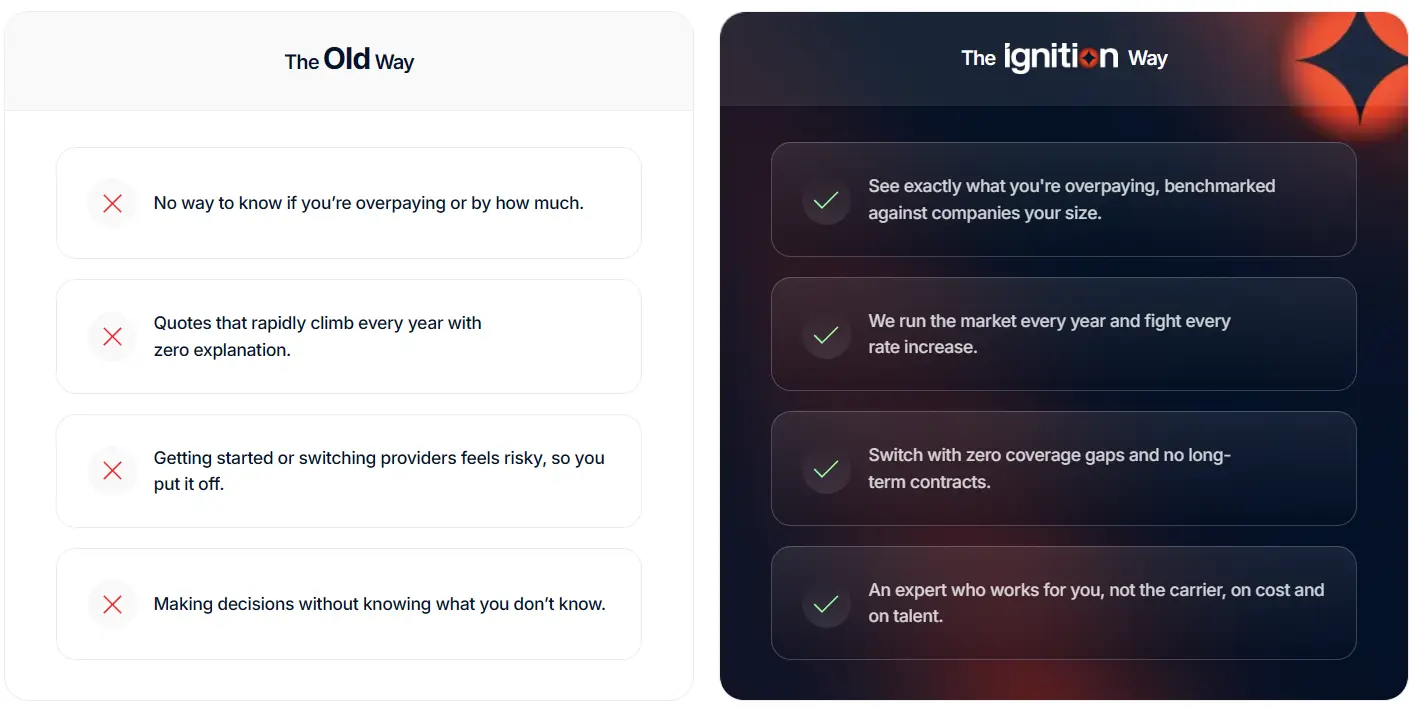
A young, healthy team is cheap to cover, but a fully-insured premium often doesn't drop to match. The carrier adds its own risk and profit, and you never see the risk score behind your price. Ignition Benefits closes this gap by pulling your risk score before getting quotes. That way, when your premium is high and your score is low, you have the number to negotiate against.
2. Nobody Has Checked the Other Carriers
Most renewals go through without a market check. The broker shows a couple of options from the same carrier, and the plan rolls over at the new price. You can't tell whether you're overpaying if nobody has gotten quotes from the other carriers.
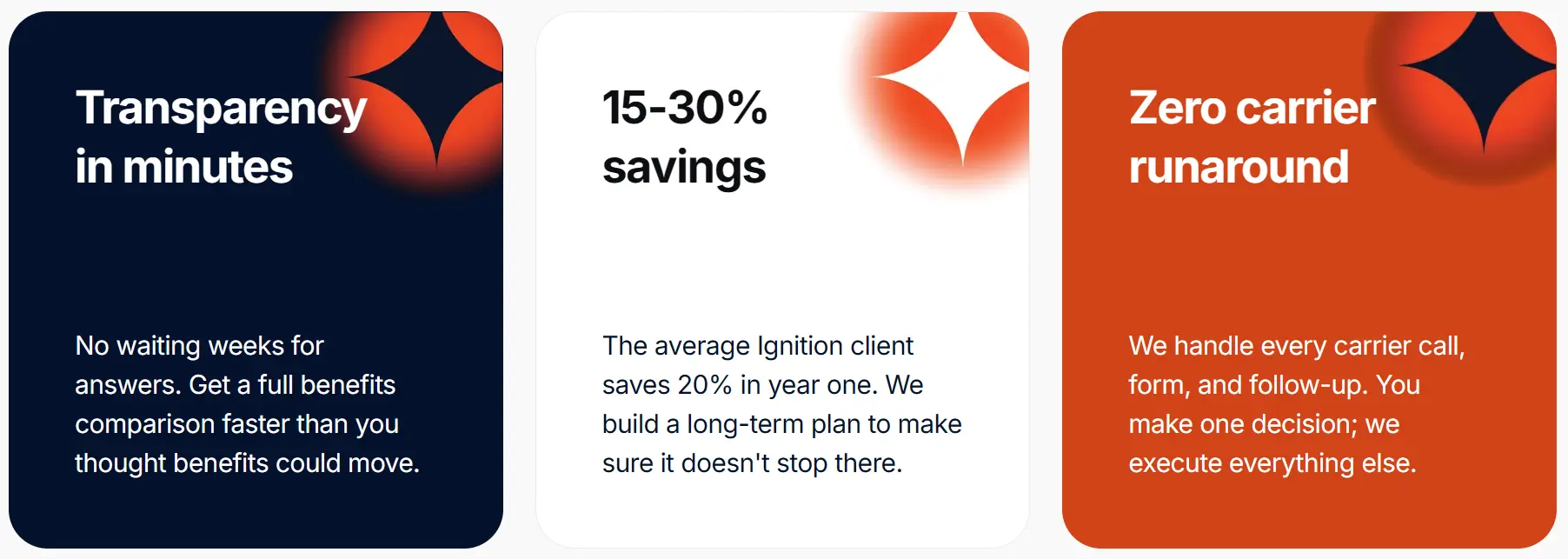
Ignition gets quotes from every carrier at each renewal, across every plan and funding structure, and gives you a Benefits Analysis Report in 14 to 21 days instead of the usual 8 to 12 weeks.
3. You Don't Have an HR Team to Run Benefits
Most founders assume they need an HR director who knows the benefits market to get them a better deal, but they don’t. Ignition is built for the founder, CFO, or ops lead who makes the decision, and it runs on two 15-minute calls: one to share workforce data and another to go over the proposal. In between, Ignition does the analysis, the quotes, and the report.
4. You Can't See How Your Broker Gets Paid
When your broker's pay rises with your premium, you can't trust the renewal advice. You have a legal right to ask for that pay in writing. Ignition shows you exactly what it's paid on day one, including its own commission, so you can check the advice against what the broker earns from it.
Find out whether you're overpaying while you can still switch, not after your renewal locks you in for another year. Share your employee census, and you'll see your real benefits cost next to what companies your size pay. Run a full-market benefits audit with Ignition Benefits.
Stop Renewing Blind. Find the Right Health Insurance Alternative for Your Team
Knowing what each plan offers is the easy part. Level-funded plans give a healthy team money back, ICHRAs and QSEHRAs give employees a fixed tax-free amount to buy their own coverage, and self-funding fits larger groups that can pay claims directly.
What’s really difficult is understanding which one costs you the least, and that comes down to who gets quotes from every carrier for your team.
If you're facing a renewal increase, the next step is to get the carrier's risk score on your own team and quotes from every carrier before you sign. Get a free benefits review from Ignition Benefits and get a clear recommendation in 14 to 21 days.
FAQs
Can a Small Business Offer Health Benefits Without a Group Plan?
Yes. A QSEHRA or ICHRA lets you reimburse employees tax-free for individual coverage instead of buying a group plan.
What Is the Minimum Number of Employees Needed for Group Health Insurance?
Usually one, though many carriers require a minimum share of eligible employees to enroll, often around 70%, before they'll write a group plan.
Are Health Insurance Alternatives ACA-Compliant?
Yes. An ICHRA can satisfy the ACA employer mandate when the amount you offer is affordable, and level-funded and self-funded plans are recognized structures under federal law.
How Long Does It Take to Switch From Traditional Group Health Insurance to an Alternative?
It varies. A broker getting quotes from every carrier and giving you a recommendation can take as little as 14 to 21 days, though the coverage itself starts at your plan year.
Does Switching Health Insurance Plans Disrupt Employee Coverage?
Usually no. Changing brokers or funding structures is an administrative change timed to your renewal date, so employee coverage continues without a gap.



_%20Which%20One%20Wins%20for%20Your%20Team_.webp)

![How to Reduce Small Business Health Insurance Costs [2026]](https://cdn.prod.website-files.com/69f22330e53a32bb7629af15/6aa04b2f5dbdf3dc6b28b351_How%20to%20Reduce%20Small%20Business%20Health%20Insurance%20Costs%20%5B2026%5D%20(1).webp)
.webp)




.webp)



.webp)










.webp)





.webp)








.webp)




.png)

