.svg)

.svg)


.webp)

- The average PEO costs $1,395 per employee per year in administration fees alone - health insurance, workers' compensation, and implementation are all billed separately on top.
- PEO pricing is rarely published. Most providers offer only custom quotes, with the final cost often ending up higher than expected due to add-ons, early termination fees, and renewal increases.
- Health insurance is the largest cost in most PEO relationships. Employers pay an average of $7,583 per employee per year for single coverage, yet PEOs don't run a market audit or share the risk score carriers use to set the premium.
- Ignition Benefits is an independent benefits broker that runs a full market audit at every renewal to find you the same/better coverage at a lower cost - all this with $0 to the employer.
“How much does a PEO cost?” is a straightforward question that rarely gets a straight answer.
Most PEOs don’t publish their pricing, don’t offer consistent quotes across headcount and location, and don’t deliver final bills that match what was discussed on the sales call.
This guide breaks down how PEO pricing actually works, what you’re paying for, where hidden costs show up, and whether an alternative setup could deliver better value for your investment.
How Much Does a PEO Cost?
The average PEO cost per employee is $1,395 per year as per the white paper published by NAPEO. This figure covers the administration fee only. Health insurance, workers' compensation, and other benefits are billed separately on top.
The administration fee itself is charged one of two ways: a flat rate per employee or a percentage of total payroll. Which model you're on affects how costs scale as your headcount and salaries grow.
Here's the full picture of what you'll pay:
Note: Sources (in order of appearance): PEOcompare, KFF, NASI, and PEO Consulting Partners
Ignition Benefits: A Cost-Effective Alternative for Health Benefits
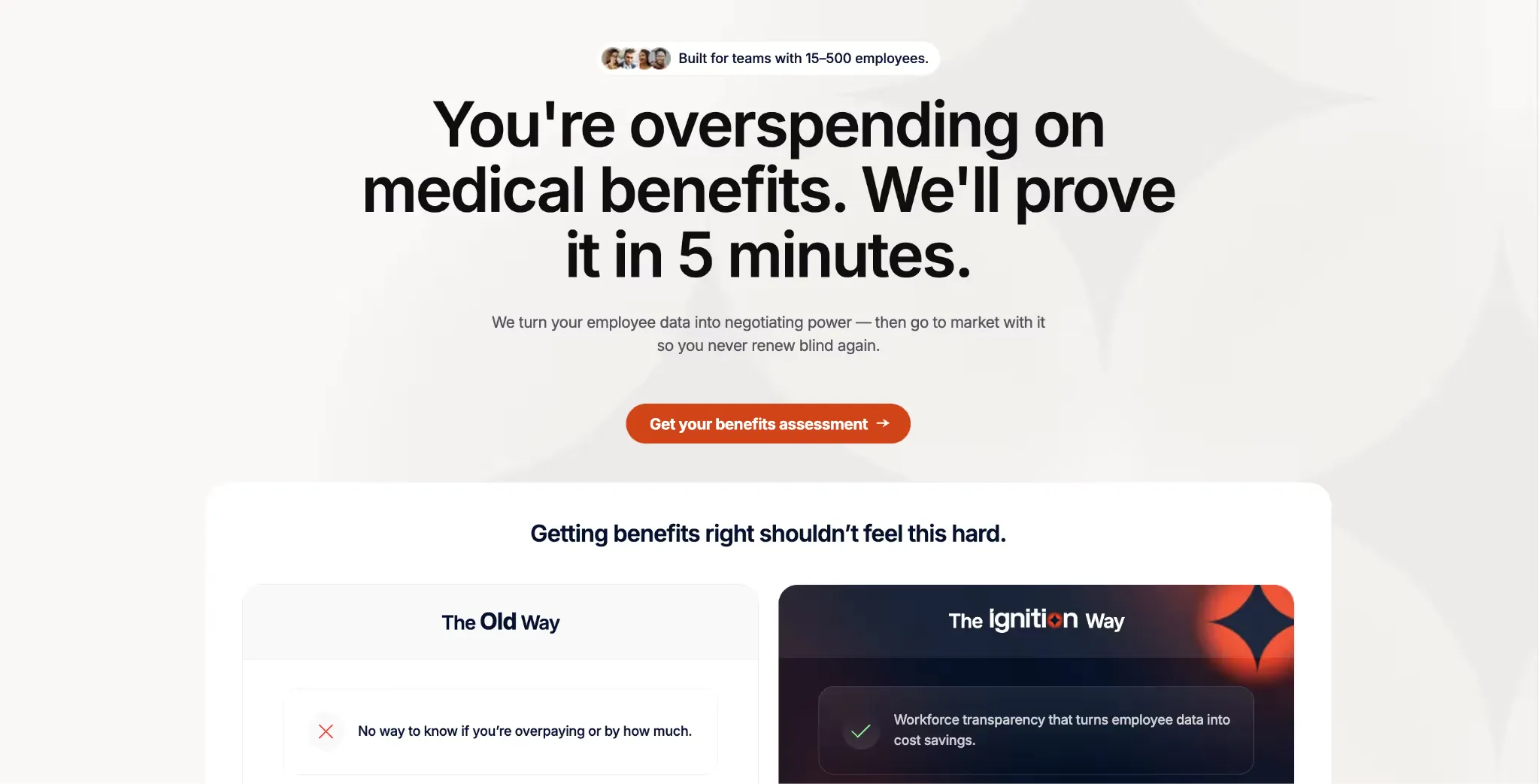
Before diving deeper into PEO pricing, it's worth understanding where most of the cost actually sits. For the majority of companies on a PEO, health insurance is the single largest expense - often 3-5x the administrative fee.
Ignition Benefits is an independent employee benefits brokerage built specifically for companies with 10-500 employees. Unlike a PEO, Ignition's entire focus is getting you the right health coverage at a price that reflects your workforce's actual risk profile.
For optimizing the cost of health benefits, Ignition:
- Runs a full market audit at every renewal: It bids across every available carrier and plan, not just the options in a PEO's preferred pool.
- Shares your workforce risk score upfront: Every carrier already has a risk score on file for your team, which is used to set the premium. Ignition shares it with you before a single quote arrives (no other PEO does this).
- Sends a Benefits Analysis Report in 14-21 days: A full benchmarking report comparing your current plan against the market. Traditional brokers take 8-12 weeks to produce the same review.
- Comes at zero cost to the employer: Ignition earns through standard carrier commissions, fully disclosed from day one.
Ignition works alongside your existing payroll and HR software, so you don’t need to make any major changes to your tech stack.
If you are comparing administrative models, exploring an ASO vs PEO breakdown can help clarify which structure offers the right balance of cost and flexibility.
Find out if you’re overpaying for employee benefits. Get your free benefits assessment now →
PEO Pricing: A Full Breakdown
Here's a detailed breakdown of each PEO cost component you read above:
1. Administration Fee
This is the base PEO fee. Basically what you pay for payroll processing, HR support, compliance guidance, and platform access.
According to PEO Compare, it's either charged as a flat per-employee rate ($40-$160/month) or as a percentage of payroll (2-12%).
The percentage model works well when pay is consistent, but can get expensive if you pay regular commissions or bonuses. The flat rate is better suited for companies where employee pay fluctuates month to month.
The range is wide as PEO admin fee depends on several factors:
Here's a detailed breakdown of each PEO cost component you read above:
1. Administration Fee
This is the base PEO fee. Basically what you pay for payroll processing, HR support, compliance guidance, and platform access.
According to PEO Compare, it's either charged as a flat per-employee rate ($40-$160/month) or as a percentage of payroll (2-12%).
The percentage model works well when pay is consistent, but can get expensive if you pay regular commissions or bonuses. The flat rate is better suited for companies where employee pay fluctuates month to month.
The range is wide as PEO admin fee depends on several factors:
2. Health Insurance and Benefits
Health insurance is billed separately from the PEO admin fee and is typically the largest single cost in the relationship. PEOs access group rates by pooling all their client companies together. This gives smaller businesses access to premiums they couldn't negotiate independently.
The catch is that your premium is partly determined by the claims history of every other company in that pool, not just your own team. For a young, healthy workforce with a low risk profile, this often means overpaying.
According to the KFF 2024 Employer Health Benefits Survey, employers pay an average of $7,583 per employee per year for single coverage and $19,276 per employee per year for family coverage - on top of the PEO administration fee.
3. Workers' Compensation
Workers' compensation is billed separately from the PEO administration fee and priced as a percentage of payroll.
According to the NASI, employer costs for workers' compensation were $1.01 per $100 of covered wages in 2021. Rates vary significantly by state and industry - from under $0.50 per $100 in low-risk states to over $2.00 in high-risk states.
4. Implementation and Setup
Most PEOs charge a one-time setup fee to migrate your data, configure the platform, and onboard your team. According to PEO Consulting Partners, these fees range from $500-$5,000 and are often not included in the advertised quote.
Some PEOs waive this fee entirely, particularly for larger contracts or longer commitments.
What Are PEO Hidden Costs?
Apart from the implementation fee, below are the costs that tend to surface after you've signed the contract:
- Per-employee charges for add-ons: Many PEOs charge extra for tools like time tracking, performance management, and recruiting, even when they’re presented as part of the base offering. Technology, per-check, and report fees are common charges that are often overlooked and worth questioning.
- Minimum headcount fees: Some PEOs charge a minimum monthly fee regardless of how many employees you have, which hits small companies harder.
- Renewal premium increases on health insurance: PEOs renew you into the same carrier pool at a higher rate each year without shopping the market. Annual increases of 15-20% are common and rarely explained.
- Early termination fees: Most PEO contracts run 12 months minimum. Exiting early can trigger penalties.
- State expansion fees: If you hire in a new state, some PEOs charge additional setup fees. This is rarely mentioned in the initial sales conversation.
Pro tip: Before signing a PEO contract, ask for a complete fee schedule that includes every possible charge, not just the per-employee rate. Request a sample invoice if possible.
PEO Pros and Cons
The case for a PEO is straightforward at the early stage. The case against it gets stronger as your headcount and benefits spend grow.
PEO Pros
- Lower health insurance costs: Small companies gain access to group rates through the PEO’s pooled client base, rates that would be difficult to secure on their own at that size.
- Compliance handled automatically: State-specific employment law, new hire reporting, and ACA filings are tracked and updated without requiring any action from your team.
- Payroll runs without manual oversight: Multi-state payroll, tax filings, and W-2 preparation are processed end-to-end, reducing the risk of errors and penalties.
- HR expertise without a full-time hire: Certified HR professionals are available on-demand for complex employment questions at a fraction of the cost of an in-house hire.
- Frees up founder time: HR administration, compliance, and benefits management are fully handled, giving founders back the time and mental bandwidth to focus on building the business.
PEO Cons
- No benefits market audit: PEOs present options from their preferred carrier pool at renewal. They do not run a competitive bid across the full market or share the risk score carriers use to price your workforce. For a founder, that means you're accepting whatever rate the PEO brings to the table with no data to push back on.
- Opaque pricing: Most PEOs don't publish pricing. Custom quotes make comparison difficult and give the PEO significant pricing leverage.
- Hidden fees: Add-ons, minimum fees, early termination charges, and renewal increases can push the real cost significantly above the advertised rate.
- Co-employment lock-in: Exiting a PEO often means rebuilding your HR infrastructure from scratch with most providers. This creates inertia that keeps companies in the relationship longer than it’s useful.
Who Is a PEO Best For?
The PEO model isn't right for every company, but for certain stages and situations, it's hard to beat. Here's where it makes the most sense.
- Early-Stage Startups (Under 10 Employees)
Companies at this stage often don't have an HR hire and need a way to offer benefits and handle compliance without building infrastructure from scratch. A PEO provides immediate access to group health rates and compliance support that would be difficult to access independently. The administrative cost is relatively low at this headcount and the convenience value is high.
- Companies Without a Dedicated HR Function
For founders managing HR themselves, a PEO removes significant administrative burden; payroll processing, state tax registration, employment law updates, and benefits enrollment. If the alternative is founder time spent on HR admin, the PEO fee often pays for itself quickly.
- Companies in High-Compliance Industries or Multi-State Operations
Managing a team across multiple states means dealing with different labor laws, tax setups, and reporting requirements in each location.
A PEO that handles this automatically, including setting up tax accounts as you hire in new states, becomes especially useful for remote-first companies growing quickly.
You can also research the best PEO services to see if your current stage aligns with their offerings. Here's where it makes the most sense.
PEO Customer Reviews
Reviews differ widely from one PEO to the next. Here's what users of three of the most popular PEO providers (Justworks, Rippling, and TriNet) are saying:
Justworks reviews
Danielle W. shares, “This is my #1 choice for PEOs. The platform is easy to use and navigate, organized and well laid out. From onboarding employees, setting up and enrolling in benefits, 401k, to making personnel changes to salary, titles, etc. this platform is the absolute best.”
Will C. says, “Justworks doubled our benefits costs after the first year (literally DOUBLED).”
Rippling reviews
Jonathan S. shares, “We're a stealth (for now) venture-backed software startup, and I'm the only operations team member. Rippling's product (plus the PEO) gives me operational superpowers, which allows our team to stay product-heavy and operationally lean.”
Ashley G. says, “The PEO was delayed, but they assured us it wouldn't be a problem if we would just sign up for their other services. So we proceeded with their request. In the end, the PEO was offered, but at higher rates than normal plans.”
TriNet reviews
Andrew G. shares, “TriNet has helped simplify payroll and HR for our company. From a finance side, it keeps payroll organized and reduces the amount of manual work we have to handle internally. The platform is straightforward to use, and processing payroll is consistent and reliable.”
Mike C. says, “The admin fees feel a bit high, especially since the offering seems limited to basic policies and handbooks for the company, and we still have to create many of our own policies and our handbook, even at the state level. Also, the health insurance options seem somewhat limited for our area.”
Alternative to a PEO: Ignition Benefits
A PEO handles the administrative side of employment well. What it doesn’t do well is push for a better deal on your largest cost, health insurance.
Premiums increase year over year, options are limited to the PEO’s preferred pool, and your workforce’s risk profile isn’t used as leverage. For a founder watching benefits spend rise, that’s a structural issue. Ignition Benefits was built to solve it.
Ignition was founded by Nick Taranto (who scaled Plated to 1,500 employees before its acquisition by Albertsons) after watching brokers earn commissions at every renewal without ever shopping the market on his behalf. He built the brokerage he wished had existed.
Ignition pairs cleanly with any existing payroll or HR platform. Switching your benefits doesn't require leaving your current setup. A single Broker of Record letter appoints Ignition as your benefits agent, and everything else stays exactly as it is.
Here's how Ignition approaches benefits differently:
Benefits Risk Score and Full Market Audit
Every insurance carrier calculates a risk score for your workforce based on age, gender, and location. That score drives your premium, but most founders on PEOs have never seen it.
Ignition shares that score with you before going to market, then runs a competitive bid across every available carrier and plan. The audit includes a funding structure review: should your company stay on a fully insured plan, move to level-funded, or consider self-insurance?
Benefits Analysis Report
Ignition delivers a full Benefits Analysis Report in 14-21 days compared to the 8-12 weeks a traditional broker takes to produce the same review. The report shows how your current plan compares to every option on the market, written in plain language for founders rather than HR teams.
Put side by side, the difference between Ignition and a traditional PEO benefits arrangement is significant not just in cost, but in what information you have access to when making decisions about your team's coverage.
Is PEO Pricing Right for Your Business?
A PEO makes sens when the convenience of bundled HR, compliance, and benefits access outweighs the cost of the arrangement. For early-stage companies without an HR function, that trade-off often works in their favor.
As you grow, the math changes. Benefits costs rise with each renewal, the pool pricing model starts working against healthy teams, and the administrative fee compounds across a larger headcount. At that point, it’s worth getting an independent view of whether what you’re paying reflects what your workforce should actually cost to insure.
Ignition Benefits provides that view at no cost. If your current setup is fair, you’ll know it. If it isn’t, you’ll have the data to act on it.



_%20Which%20One%20Wins%20for%20Your%20Team_.webp)

![How to Reduce Small Business Health Insurance Costs [2026]](https://cdn.prod.website-files.com/69f22330e53a32bb7629af15/6aa04b2f5dbdf3dc6b28b351_How%20to%20Reduce%20Small%20Business%20Health%20Insurance%20Costs%20%5B2026%5D%20(1).webp)
.webp)




.webp)



.webp)

.webp)









.webp)





.webp)







.webp)




.png)

