






- Your carrier prices you off your own claims history and workforce demographics. You have almost certainly never seen that analysis, and it is what you need to take control of your plan.
- How your plan is funded decides who keeps the money in a healthy year. At small companies, it is usually the carrier.
- The average family plan now costs $26,993 a year. Small companies pay more toward thinner coverage than big ones do.
- Broker commissions sit inside your premium, typically 3 to 6%, often with carrier bonuses on top. On percentage commissions, your broker earns more when your premium rises.
- Your renewal arrives 30 to 60 days out. That short window is the carrier's leverage, and a serious renewal starts at 120 days.
The gap in every guide
There are a lot of guides about health insurance for founders. I've read most of them.
They're all organized the same way. Here are your options. Here's what fits your headcount. Here's a table comparing them.
Useful. And they all skip the part that costs you money.
None of them tell you how your price gets set. Which carrier looked at which data about your team. What is in that analysis. Whether you can see it. What you can do about it.
That omission is the whole thing. You can pick the right product and still overpay for years.
I was that founder for five years at Plated as we scaled to over 1,000 employees. Our benefits broker never once shopped our plan or showed me our claims data, and I overpaid by over $4M without knowing it.
So this guide covers both. The options, because you do need to pick one. And the mechanics, because that is where the decision gets made.
Already have a broker? Skip to how your plan is funded and what happens at renewal. That is where most of the money is.
Before we start, I should say plainly that I run a brokerage, so read the advice accordingly. We built Ignition to do this differently. You can judge that at the end.
Are you even required to offer it?
Probably not. Worth settling before you spend a week researching plans.
The federal ACA employer mandate kicks in at 50 full-time-equivalent employees. Below that, nothing in federal law requires you to offer health insurance.
Full-time equivalent matters. Two people at 15 hours a week count as one full-time employee for the calculation. The test uses your average headcount across the prior calendar year, so crossing 50 heads in June does not make you an applicable large employer that year. Whether it does next year depends on that year's average.
Two things that catch founders off guard. Companies under common ownership get combined and treated as a single employer for the headcount, so a founder with two entities may be closer to the line than they think. And Hawaii has its own employer mandate for anyone working 20 or more hours a week, and San Francisco requires many employers to meet a minimum health spend. Check your state and city.
So why do most startups offer it anyway? Because the people you want to hire expect it, and because without a group plan your own coverage is an individual-market problem. That makes it a competitive decision, and one you get to make.
How health insurance works in the US
In 1942, with the country at war and factories short of workers, Congress froze wages to fight inflation. Employers needed people, and the obvious tool, paying more, was now illegal.
Fringe benefits did not count as wages. So companies competed on the one thing left.
Then in 1943 the IRS ruled that employer-paid premiums were not taxable income. Regulators called it a negligible cost.
About 9% of Americans had health insurance in 1940. By 1953, 63% did. Congress wrote the arrangement permanently into the tax code in 1954.
That negligible cost is now the single largest tax expenditure in the federal code, roughly $300 billion a year.
Other wealthy countries rebuilt their health systems deliberately after the war. We kept the workaround and built on top of it for eighty years.
Which is why you are the one signing.
Today 154 million Americans get coverage through a job. The employer funds it, the carrier prices it, the broker sells it, and the employer is the only party in that chain that cannot see the math.
What your options are
There are four ways to cover your people. Most founders only hear about two.
Individual coverage. Just you and a cofounder. COBRA from your last job, a spouse's or parent's plan, a professional or alumni association, or the marketplace. Compare them on your actual medical needs first, then on price.
ICHRA or QSEHRA. You set an allowance, employees buy their own plans, you reimburse tax-free. Your cost becomes a number you choose.
The trade-off: employees front the money, wait for reimbursement, and do their own shopping.
One structural point worth knowing now: ICHRA scales past 50 employees, and QSEHRA stops at 50.
PEO. Brand-name coverage at large-group rates, bundled with payroll and HR. Real advantages early. Two things to watch: the admin fee is a percentage that grows with payroll and usually climbs after year one, and the contracts tend to run twelve months.
Around 50 employees, a healthy group can often price better standing alone than inside a PEO's pool. Check before you renew.
Small group coverage. Your own plan, your own contract. You choose what's offered, which means you can put a strong plan in an offer letter. Worth comparing once you have enough scale and geographic concentration to price it well.
Pick one of those four and you have answered half the question. The other half is how the thing gets funded, and almost nobody explains that part.
How your plan is funded
Two companies can buy the same plan from the same carrier and have completely different economics. Funding structure decides who carries the risk and who keeps the money.
Fully insured. You pay a fixed premium. The carrier pays the claims. If your team has a healthy year, the carrier keeps most of the surplus. Federal rules require a rebate when a carrier spends less than 80% of small-group premium on care, and that rebate is calculated across the carrier's whole book in your state. Your healthy year mostly subsidizes other groups. A bad year is the carrier's problem until your next renewal prices it in. Predictable, and the default for most small groups because it is the only option most brokers put in front of them.
How fully insured plans work →
Level funded. You fund claims up to a monthly cap, with stop-loss insurance above it. Your payment looks like a premium, and unused claims money can come back to you at year end. The carrier still carries the catastrophic risk. The practical middle ground, and available to groups well under 100 lives: 37% of covered workers at firms with 10 to 199 employees are already in a level-funded plan, according to KFF.
Self-insured. You pay claims directly out of company money, with stop loss for the big ones. You keep the surplus in a good year and you absorb the volatility in a bad one. You also see your own claims data as a matter of course, which is the part most founders do not realize they are giving up.
Captive. A group of employers pools into a jointly owned insurance entity and shares risk. It gets a 60-person company closer to self-insured economics without carrying that risk alone. More administration, and a multi-year commitment.
How captive and self-insured plans work →
Why this is the lever
At large companies, 80% of covered workers are in self-funded plans where the employer keeps the surplus in a healthy year. At firms with 10 to 199 workers it is 27%.
So most small employers hand over the premium, have a healthy year, and never see the money again.
Nobody chose that default. It is also the thing you have the most control over, and the question almost never gets asked.
How to find out which you are in. Ask your broker, in those words. I was fully insured for five years and nobody ever told me there was a choice. If the answer is fully insured and nobody has walked you through the alternatives, start that conversation.
Level funded vs fully insured, side by side →
What it actually costs
According to the KFF 2025 Employer Health Benefits Survey, the average annual premium for employer-sponsored coverage is $26,993 for family coverage and $9,325 for single coverage. Workers contribute about $6,850 toward the cost of family coverage through payroll deductions.
That is more than a new economy car. Every year. Per family.
Ten people on employee-only coverage costs roughly $79,000 a year at the typical employer contribution. Put five of them on family coverage and you're near $140,000.
For most small companies, that is one of the largest line items after payroll. It is also the only one of that size where most founders cannot tell you what drives the number.
What employee benefits actually cost in 2026 →
Small companies pay more for less
Workers at firms with 10 to 199 employees contribute about $8,889 toward family coverage. At larger firms it is $6,227. Single-coverage deductibles run $2,631 against $1,670, according to KFF.
Worse pricing and thinner coverage, at the same time, for the companies least able to absorb it.
And it compounds. This year's gap becomes the baseline for your next renewal.
You can skip the national average. Two calculators will give you your own number, and neither needs a signup or a call.
See what one hire actually costs you →
See what you are spending on benefits per head →
Price and drug mix drive your bill
The intuitive explanation is utilization. Your people are getting sick, going to the doctor, and running up claims.
The data points elsewhere. Americans use less care than people in peer countries. Fewer doctor visits per person. Fewer hospital stays. Yet we pay roughly double per person.
So when your renewal jumps, the honest answer is usually price and drug mix. What hospitals near your people charge, which drugs your team takes, and the structure you happen to be sitting in.
What moves your number
Three things, and none of them are visible on your quote.
Provider prices. Employer plans pay hospitals about 254% of the Medicare rate for the same service in the same building, based on RAND's 2022 data. Only Arkansas comes in under 170%. Eight states are over 300%, including California. RAND found hospital market power explains much of that variation. So it often comes down to who owns the systems near your people.
Pharmacy. US drug spending rose 12.7% in 2025 to $915 billion. GLP-1s were $132 billion of that, and ASHP traced most of the growth to more people taking more medications. On employer plans, GLP-1 claims went from under 7% in 2023 to over 11% now. If your renewal moved and nobody got sick, this is often where it came from.
Funding structure. Who keeps the money in a healthy year. Covered above, and the one you have the most control over.
The Benefits Blind Spot Report has what 503 SMB leaders told us about what they can and cannot see in their own benefits spend. Most could not name a single one of the three drivers above.
Seeing it for your own company
Everything above is national data. Your number is built from your claims history and workforce demographics. Carriers run that analysis on every account, whether or not anyone shows it to you.
That is what health risk analysis does at Ignition. We get access to the same workforce health and risk data carriers use to underwrite you: age mix, claims trends, plan design, and enrollment patterns. You see whether your rate reflects your workforce or somebody else's.
Then we put it to work. That data is what lets us take your plan back to market and make carriers compete for it.
It is the first thing we run for a new client, and it is usually the first time they have seen it.
See how our health risk analysis works →
How brokers and carriers make money
Here is the part that took me years to work out.
Broker compensation is built into your premium. Typically 3 to 6%, often with carrier performance bonuses on top. You pay it either way. You just never see the line.
On percentage commissions, your broker's pay rises with your premium, including the increase they are advising you to accept. Some small-group deals pay a flat amount per employee per month instead, so ask which one you are on.
You can get a rough figure in about a minute. Put in your headcount and premium, then ask your broker for the real number and see whether the two match.
See what your broker earns on your account →
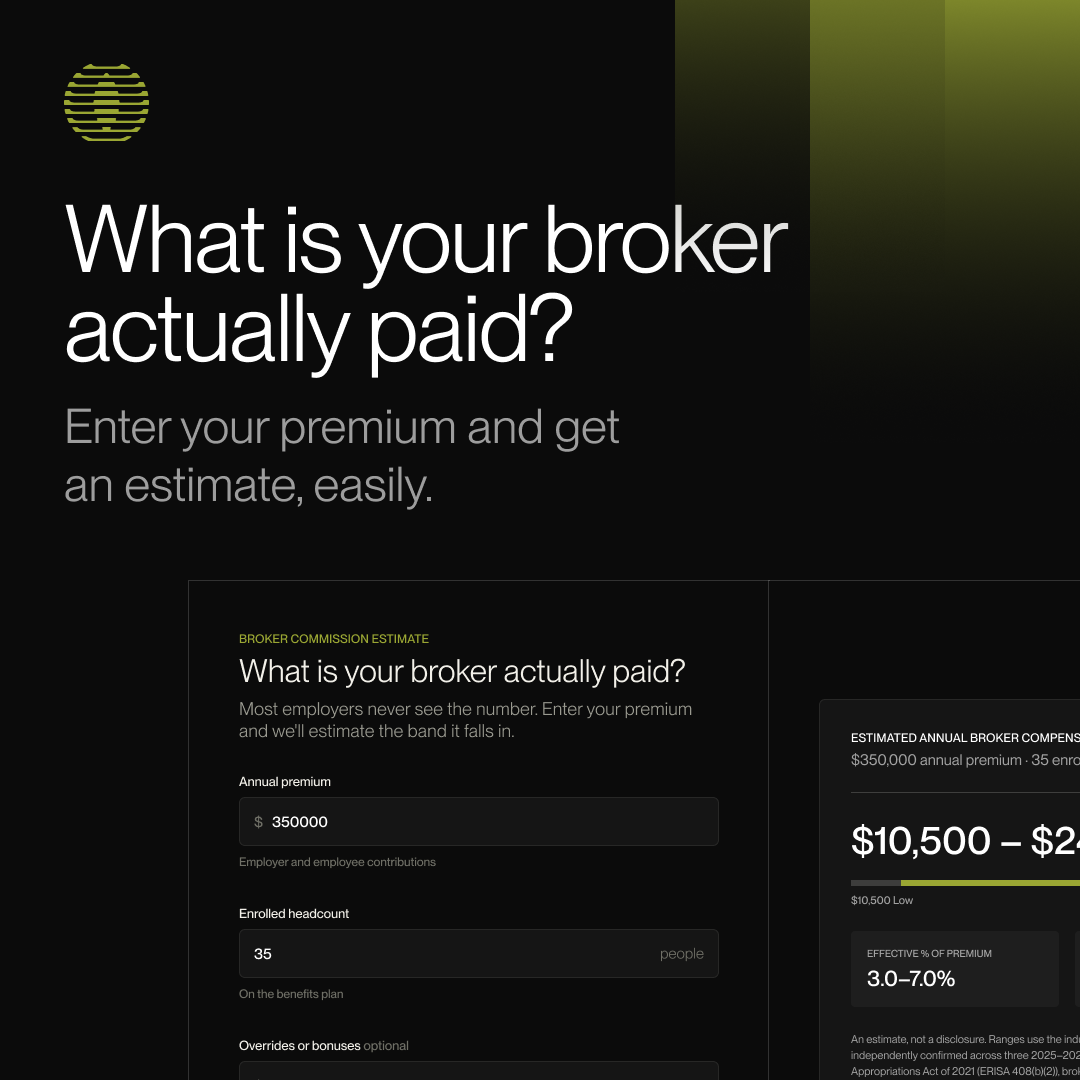
Most brokers are decent people working inside a compensation structure they did not design. Know the structure before you weigh their advice.
Since 2021, federal law has required brokers to disclose what they earn on your account. Ask. In writing. The ones who get weird about it have just answered you.
Carriers have their own math. Medical loss ratio rules let a carrier keep up to 20% of small-group premium for administration and profit. Pharmacy benefit managers add another layer through rebates and spread pricing that rarely show up on an employer's invoice.
At Ignition, we disclose our compensation up front, and it does not vary by which carrier you choose. That matters because our job is to make carriers compete for your plan, using your own risk data.
See how we take a renewal to market →
How to read your quote
Seven things on the page. Most founders can define maybe three.
Premium. What you pay monthly to have coverage.
Deductible. What an employee pays before the plan starts paying.
Out-of-pocket maximum. The annual ceiling on what an employee can spend.
Coinsurance. The percentage split after the deductible.
Network. Which doctors are covered.
Funding structure. Who pays the claims and who keeps the surplus.
Fees. Administration, and anything bundled in.
Then there is plan type, which describes network rules. It says little about price on its own.
Ask for one of each, priced on the same census. Geography decides it. One metro area? Take the narrow network and save the money. Scattered team? Pay for the wider one.
The seven types of group insurance, explained →
What happens at renewal
Your renewal shows up 30 to 60 days before the effective date. In California, 60 days' written notice is the legal minimum. A number, a short explanation about the market, and a signature line.
Sixty days is too short to pull your data, shop the market, gather a census, get competing quotes, and move your team. Everybody involved knows that.
The short window is by design. Your deadline is their leverage.
Two documents you should ask for and have probably never seen. Ask for your claims experience report and your large claim report, by name. They show you exactly what drove your cost. If nobody will hand them over, that tells you something on its own.
When to start. A serious renewal process starts about 120 days out. That is long enough to pull your data, take the plan to market, and get real quotes back while you can still say no. Remove the deadline and the whole conversation changes.
That's why we start renewals at 120 days. It is the time the work actually takes.
What a re-bid looks like. We take your claims experience and workforce data back to your carrier and market it against the alternatives. Carriers then price against each other on your actual risk.
On switching. It is one piece of paper. Your employees notice nothing. Coverage does not lapse, and the network changes only if you choose to change it. AWM Capital was facing a 20%+ renewal increase. They ran the whole switch in two 15-minute calls, reversed the increase, cut $156,914 off their annual cost, and added Mayo Clinic access in the process.
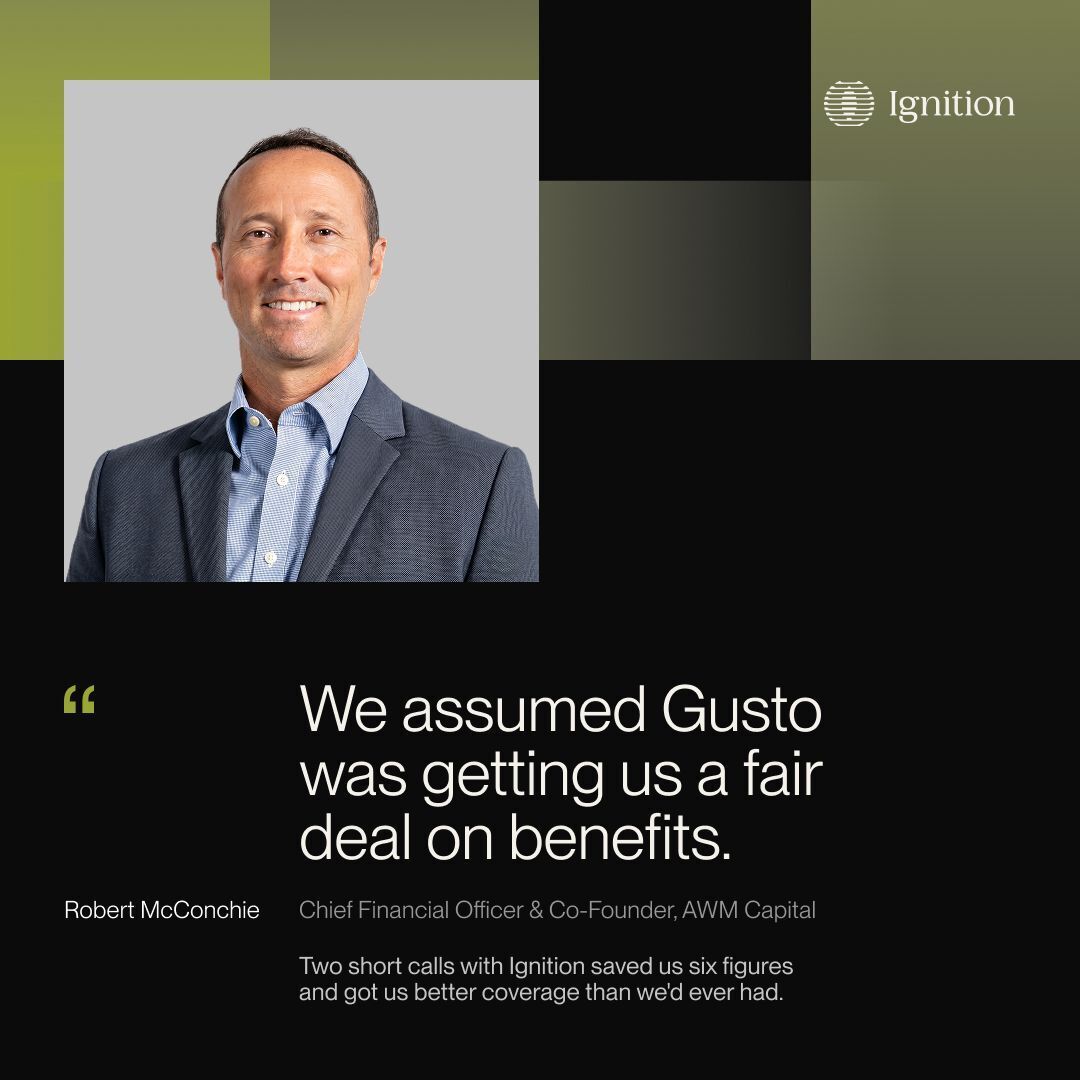
The system is hard to change. Changing your broker takes two calls.
See how we can help with your renewal →
Ask Ignition AI
I think the acronyms are deliberate. American health insurance adds complexity where none is needed, and the complexity is doing a job. Knowing what a deductible is takes a glossary. Knowing what yours means for your team takes your data.
This guide can only do the first one. Ask Ignition AI does the second.
Ask a question about your own plan and get an answer right away. Why did my renewal move? What does this deductible mean for someone on $60k? Should I be looking at level funding?
The same system runs benefits admin in the background, alongside the payroll and HR tools you already use. It processes submissions and catches a missed deadline before it turns into a coverage gap. That's why the eight-to-twelve-week benefits process collapsed for our clients. Most of those weeks were waiting, and the waiting is gone.
We also advocate for your employees directly. When someone on your team is stuck on a claim or a bill, they come to us.

A person stays on your account. Licensed experts still compare the plans, take your renewal to market, and walk you through the options. The AI surfaces what to look at and answers questions in context, so nothing sits in a black box waiting for someone to explain it to you.
Choosing as you grow
If you read nothing else, read this. It is the decision, by headcount.
Wherever you land on that table, there is a version of this built for it.
Benefits for small businesses →
Benefits for mid-market companies →
What's next for you
I was the founder who thought I knew how to navigate the US healthcare system. I was wrong. It cost me over $4M, and the worst part is that the information was available the entire time.
Nobody handed it to me. So we built the place that hands it to you.
So here is the smallest possible next step. Book a demo. It takes a few minutes, with no cost and no commitment. We will show you the data your carrier already uses to price you, so you have what you need to push back.
Let us show you the modern way to buy health insurance for your people.
FAQs
Do startups have to offer health insurance?
Most do not. The federal ACA employer mandate applies at 50 or more full-time-equivalent employees. Below that, offering coverage is a competitive decision. Hawaii has its own employer mandate, so check your state.
How much does health insurance cost for a startup?
The average employer-sponsored family plan runs $26,993 a year and single coverage $9,325, per KFF's 2025 survey. Employers typically cover most of it. Small companies pay more toward thinner coverage than large ones do, so treat national averages as a floor.
What is the difference between fully insured and level funded?
Fully insured means you pay a fixed premium and the carrier keeps most of any surplus in a healthy year. Level funded means you fund claims up to a cap, with stop-loss above it, and unused claims money can come back to you. Level funding also usually comes with access to your own claims data, which fully insured small groups often do not get.
What is the difference between ICHRA and QSEHRA?
Both let you reimburse employees tax-free for individual coverage in place of a group plan. QSEHRA is limited to employers under 50 full-time equivalents and has an annual cap. ICHRA works at any size and has no cap. If you expect to grow past 50, ICHRA scales and QSEHRA does not.
How does my carrier decide what to charge me?
They run an analysis on your workforce using your claims history and demographics. Age mix, claims trend, plan design, enrollment patterns. That analysis exists on every account and almost no employer is shown it. It is also the data a broker needs to re-bid your plan, and it is why two companies of the same size in the same city can get very different numbers.
How do health insurance brokers get paid?
Usually a commission built into your premium, typically 3 to 6%, sometimes with performance bonuses from the carrier. Some small-group deals pay a flat amount per employee per month instead. Federal law has required brokers to disclose their compensation since 2021.
How much notice do I get before my renewal?
Usually 30 to 60 days. California requires at least 60 days' written notice of a group rate change. Start your own process about 120 days out so you have time to re-bid.