





- Start with legally required benefits. Social Security and Medicare, unemployment insurance, workers’ compensation, and applicable leave requirements form the baseline of your benefits package.
- Build a strong core benefits package. Health insurance, dental and vision coverage, retirement plans, life and disability insurance, and paid time off are benefits employees commonly expect from a competitive offer.
- Use fringe benefits to address your workforce’s needs. Commuter benefits, education assistance, dependent care, and flexible work can add value when they align with your employees’ work arrangements and personal needs.
- Use voluntary benefits to expand coverage without adding the full premium cost. Employers can offer options such as supplemental life, accident, critical illness, hospital indemnity, pet insurance, and legal or identity protection plans, with employees typically paying the premiums.
- Prioritize where your benefits budget has the most impact. Focus on health plan quality and your core benefits package before adding fringe benefits or voluntary coverage.
Candidates look beyond the salary offered when evaluating a job offer. 81% of employees say benefits affect their decision to accept a position, putting benefits among the factors employers need to consider when hiring.
But which benefits should you offer, and which ones matter most to employees? Employee benefits span health insurance, retirement plans, paid time off, family benefits, and more. Some are required by law, some have become standard expectations, and others can strengthen your package once the basics are covered.
This article breaks down the four main types of employee benefits, what each one typically includes, and how to decide which benefits to prioritize for your team.
1. Legally Required Employee Benefits
Legally required benefits form the baseline of your employee benefits package. These are benefits employers are required to provide under federal or state law, so factor them in before adding optional benefits.
A couple of federal requirements come into play when you offer group health coverage or reach a certain employee count:
- Consolidated Omnibus Budget Reconciliation Act (COBRA): If you offer a group health plan and had 20+ employees in the prior year, departing employees can keep that coverage for a limited time. They can be charged up to 102% of the plan's cost, so the employer's obligation is primarily administrative (U.S. Department of Labor).
- Affordable Care Act (ACA): Once you average 50+ full-time employees, including full-time equivalents, you face a possible penalty if you don't offer qualifying coverage to full-time staff (IRS). Below 50 employees, federal law doesn't require you to offer health insurance.
State requirements also come into play, especially when you have remote or multi-state employees. A new hire can mean setting up a new unemployment account, meeting different workers' compensation requirements, and complying with that state's leave programs.
2. Market Standard Benefits Employees Expect
Market-standard benefits are the ones candidates typically expect to see in a solid offer: health insurance, dental and vision coverage, a retirement plan, life and disability insurance, and paid time off.
The benefit itself is only part of the equation. Two companies can offer health insurance with significant differences in premiums, deductibles, and out-of-pocket costs. The sections below explain what to look for in a competitive benefits package.
Health Insurance
Health insurance covers doctor visits, hospital stays, prescriptions, and preventive care. Common plan types include Preferred Provider Organizations (PPOs), Health Maintenance Organizations (HMOs), and High-Deductible Health Plans (HDHPs) paired with a Health Savings Account (HSA).
Health coverage ranks highest among the benefits employees want. In PeopleKeep's survey, 92% of employees rated it somewhat or very important.
Among employers, 59% of firms with 10-199 workers offer health benefits, compared with 97% of firms with 200 or more, according to KFF's Employer Health Benefits Survey.
What a competitive plan looks like:
- The employer pays most or all of the employee-only premium. At firms with 10-199 workers, 29% of covered employees already have their full single premium paid, according to KFF.
- The single deductible is below the small-firm average of $2,631, according to KFF.
- The employer contributes a meaningful share toward spouse and dependent coverage.
Dental and Vision Insurance
Dental insurance typically covers routine cleanings and exams, fillings, and major procedures such as crowns. Orthodontic care is often covered separately. Vision insurance covers eye exams and helps pay for glasses or contact lenses.
The same PeopleKeep survey found that 91% of employees rated dental coverage as important, while 81% said the same about vision coverage.
Access falls short of that demand as 44% of private-sector workers have dental coverage available, and 29% have access to vision coverage, according to the Bureau of Labor Statistics (BLS).
What a competitive plan looks like:
- Preventive dental care covered in full, with orthodontic coverage for families.
- A vision plan that includes an annual eye exam and an allowance for frames or contacts.
- The company covers the full monthly cost of dental and vision for each employee, so they don’t pay anything to enroll themselves.
Retirement Plans
A retirement plan helps employees build savings through payroll deductions. The most common option is a 401(k), which lets employees contribute part of each paycheck before taxes. Employers can match those contributions, though that is optional.
Retirement plans rank fourth among the benefits employees value, with 89% rating them important in the same PeopleKeep survey. That demand aligns with broad access to retirement benefits. According to the BLS, 72% of private-sector workers have access to a retirement plan.
What a competitive plan looks like:
- An employer match on employee contributions.
- A short vesting schedule. Vesting means ownership, according to the IRS, so a shorter schedule lets employees keep the employer match sooner.
- Automatic enrollment, so new hires start saving without filling out a form.
Life and Disability Insurance
Life and disability insurance help protect employees and their families from the financial impact of death, illness, or injury.
Group life insurance pays a set amount to an employee’s beneficiaries when the employee dies.
Disability insurance replaces part of an employee’s income when an illness or injury prevents them from working. Short-term disability typically covers the first few weeks or months of an absence, while long-term disability applies to extended absences.
The BLS found that 59% of private-sector workers have access to life insurance, 44% have access to short-term disability coverage, and 37% have access to long-term disability coverage.
What a competitive plan looks like:
- Employer-paid basic life insurance, set as a flat amount or a multiple of salary.
- Employer-paid short-term and long-term disability coverage.
- The option for employees to purchase additional life insurance for their families.
Paid Time Off
Paid Time Off (PTO) is time away from work that employees get paid for. It can include vacation, paid holidays, sick days, personal days, and paid family or parental leave. Some companies track each type separately, while others combine them into a single PTO bank.
PTO ranks third among the benefits employees value, with 90% rating it important in the same PeopleKeep survey. Most workers already have access to the basics: 80% of private-sector workers have paid vacation, 81% have paid holidays, and 81% have paid sick leave, according to the BLS. Paid family leave remains less common, with only 49% of workers having access even though 77% of employees rate it important.
What a competitive plan looks like:
- A clear number of vacation days, with paid holidays and sick days provided separately.
- A written paid parental leave policy covering birth, adoption, and foster placement.
3. Fringe Benefits and Differentiators
Fringe benefits are additional perks employers provide beyond salary and core benefits such as health insurance, retirement plans, and paid time off.
These benefits work best when they reflect the needs of your workforce. A commuter benefit makes more sense for employees who regularly travel to an office, while dependent care assistance can provide more value to employees with childcare expenses.
Tax treatment also matters. The IRS generally treats fringe benefits as taxable income unless a specific exclusion applies. Understanding those rules helps employers choose benefits that provide meaningful value to employees.
Below are employee benefits examples worth considering. The first three examples are based on the same IRS publication linked above.
- Commuter benefits: Employees can receive up to $340 per month in 2026 for transit and another $340 for qualified parking on a tax-free basis. This can help employees who commute to an office manage transportation costs.
- Education and student loan assistance: Employers can provide up to $5,250 per employee per year tax-free through a qualified educational assistance program.
- Dependent care assistance: The tax-free limit for a dependent care assistance program increased from $5,000 to $7,500 for 2026, giving employees with eligible dependent care expenses more room to use this benefit.
- Flexible and remote work: Flexible work arrangements can reduce commuting demands and give employers access to candidates outside a single metro area. For eligible roles, they also add value without the premium costs associated with insurance benefits.
4. Voluntary Benefits: Coverage Employees Buy at Group Rates
Voluntary benefits are additional insurance and protection options employees can choose and pay for themselves, usually through payroll deductions. Employers make these options available through a group plan, which can give employees access to rates or coverage arrangements that differ from what they could get on their own.
Because employees cover the premiums, voluntary benefits can expand the range of coverage available through an employer without adding the full premium cost to the company's benefits budget. Employers still need to account for the time and resources required to set up and administer these programs.
Common examples of voluntary benefits are:
- Supplemental life insurance
- Accident insurance
- Critical illness insurance
- Hospital indemnity coverage
- Pet insurance
- Legal and identity protection plans
Voluntary benefits work best as an addition to a core benefits package. Employees might value options such as accident or critical illness coverage, but these benefits do not replace the health insurance, retirement, and paid time off employees typically expect from an employer.
Which Benefits to Prioritize When Spend Is Limited
When benefits spending is limited, start with the benefits that have the greatest impact on employees and the overall cost of the package.
Required benefits come first, followed by the core benefits employees expect, such as health insurance, paid time off, and retirement plans. Fringe and voluntary benefits can then fill specific gaps based on your workforce.
Health insurance deserves particular attention because it represents a major share of employer compensation costs. It accounts for 7.9% of total compensation, according to the BLS. Paid leave represents 7.5%, and retirement benefits account for 3.3%.
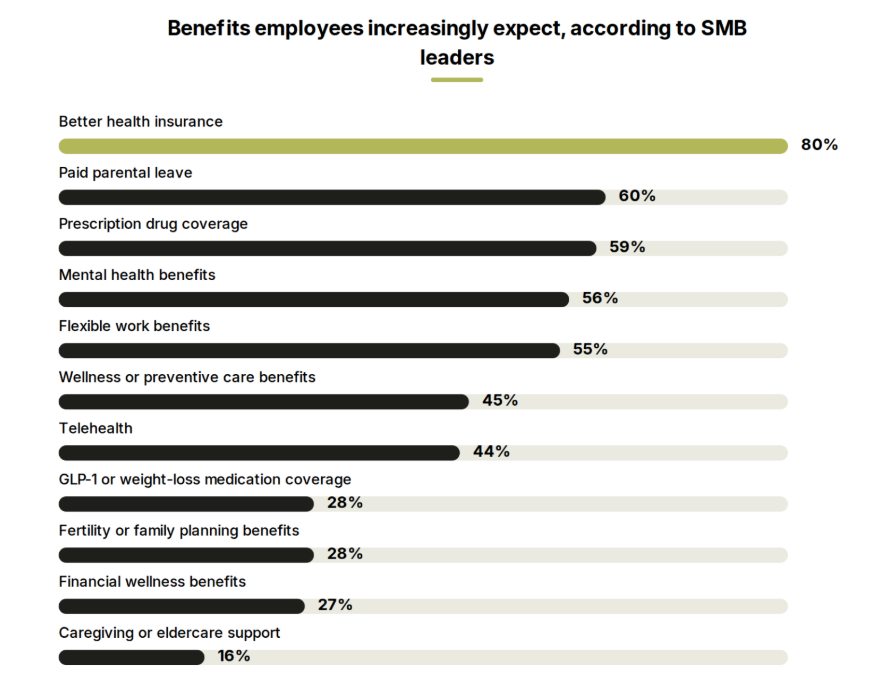
Employee expectations reinforce the importance of health coverage. In Ignition's 2026 Benefits Blind Spot survey of 503 small-business leaders, 80% said employees increasingly expect better health insurance.
Before changing your benefits package, look at whether your current spending is competitive. Only 6% of companies in the survey have checked whether they are overpaying for benefits, while 41% assume their broker already handles it. As healthcare costs rise, 64% of respondents said they made a business tradeoff to cover their latest increase, most often by cutting raises and bonuses (26%).
Funding structure is another factor to evaluate. Survey respondents estimated that fully insured plans cost $8,005 per employee per year, compared with $5,914 for level-funded or self-funded plans.
FAQs
What Are Some Examples of Employee Benefits?
Common examples include health, dental, and vision insurance, 401(k) plans, life and disability coverage, paid time off, commuter benefits, and education assistance.
What Is the Most Expensive Employee Benefit?
Health insurance is typically the largest employee benefit expense. The average 2025 family premium reached $26,993, according to KFF. Insurance also accounted for 7.9% of total compensation among private employers, making it the largest benefit cost category, according to the BLS.
What Percentage of Payroll Should Be Benefits?
Benefits average about 30% of total compensation for private employers, or roughly 43% on top of wages, according to BLS. Use this as a starting point, then adjust based on your industry, workforce, and benefits package.
What Benefits Do Employees Value Most?
Health insurance ranks among the benefits employees value most. In Ignition's 2026 survey, 80% of leaders at companies with 10-250 employees said their employees increasingly expect better health insurance, more than any other benefit.
Give Your Team Better Benefits With Ignition
Employee benefits cover everything from legally required coverage to additional benefits that address specific employee needs. The challenge is deciding where to put your benefits budget and whether your current plans deliver enough value for what you spend.
Ignition is an employee benefits brokerage built for founders who still own the benefits decision. At every renewal, Ignition runs a full market audit across every carrier and funding structure, giving you a broader view of the plans and funding options available for your team.
It also pulls your Benefits Risk Score, the same risk model carriers use to price your renewal. Together, these features help you evaluate your current benefits package, identify where your spending could be improved, and make more informed decisions at renewal.